

Best Low Light Plants for Shrimp Tanks
Table of Contents
- Best Low Light Plants for Shrimp Tanks: Quick Comparison
- Anubias Varieties: Foreground Anchors for Shrimp Shelter
- Java Fern and Attachment: Creating Dense Hiding Spaces
- Cryptocoryne Varieties: Root Feeders for Stable Growth
- Aquarium Moss for Shrimp: Biofilm and Grazing Surfaces
- Floating Plants for Shrimp Tanks: Surface Shade and Fry Refuge
- Aquarium Plants That Grow Without CO2: Why Low-Tech Works
- African Water Fern: Dense, Durable Midground Coverage
- Frequently Asked Questions
Last Updated: October 14, 2026
Best Low Light Plants for Shrimp Tanks: Quick Comparison
Setting up a low-light shrimp tank doesn't mean sacrificing plant coverage or visual appeal. The best low light plants for shrimp tanks provide shelter for baby shrimp, create grazing surfaces for biofilm, and thrive without CO2 injection or intensive lighting. At Ohenrystanksalot, we cultivate plants that arrive fully transitioned and ready to thrive from day one.
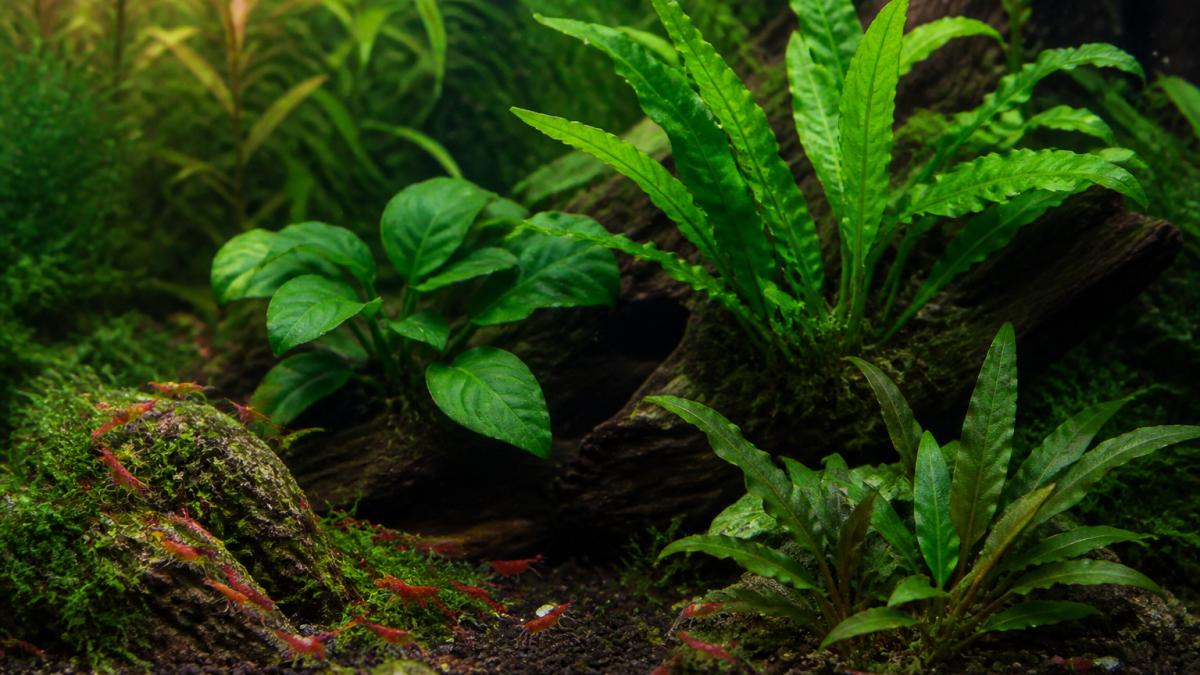
Our no-CO2 cultivation method means your plants are already adapted to freshwater conditions: they establish quickly, provide immediate cover for shrimp, and won't crash your nitrogen cycle.
| Plant Type | Light Needs | Best Tank Position | Shrimp Benefit |
|---|---|---|---|
| Anubias Nana | Low-Medium | Foreground | Dense shelter |
| Java Fern | Low-Medium | Midground | Hiding spaces |
| Cryptocoryne Parva | Any | Foreground carpet | Baby shrimp cover |
| African Water Fern | Low-Medium | Midground-Background | Biofilm surface |
Anubias Varieties: Foreground Anchors for Shrimp Shelter
Anubias plants are the foundation of most low-light shrimp tanks because they're nearly impossible to kill and create the dense foliage shrimp need. These epiphytes grow from rhizomes that must be attached to hardscape rather than buried, creating natural pockets and crevices where shrimp hide and babies survive.

Anubias Nana: The Compact Classic
Anubias Nana stays small, grows slowly, and requires minimal light. At 3-5 inches mature size, it works in foreground or midground positions, with deep green ovular leaves growing tightly around the rhizome to create a compact mound of shelter.
Anubias Nana's tight leaf arrangement traps biofilm and detritus that shrimp graze on. Anubias Barteri var. "Nana" from Ohenrystanksalot arrives fully transitioned at $4.50 per plant, affordable enough for layered coverage.
Attach Anubias Nana to driftwood or stone using fishing line or plant weights. Never bury the rhizome, or it will rot.
Anubias Minima: Elegant Midground Coverage
Anubias Minima grows taller than Nana, reaching 6-10 inches, with long slender wavy leaves. It suits midground or background positions where its height adds vertical dimension without blocking the foreground.
Baby shrimp still hide among the leaf stems, and the plant provides excellent biofilm surfaces.
Anubias Barteri var. "Minima" costs $9.00 and takes 3-4 weeks to establish on hardscape. Its slow growth makes it a one-time investment that lasts years with minimal maintenance.

Java Fern and Attachment: Creating Dense Hiding Spaces
Java ferns are epiphytic ferns that reproduce through plantlets at leaf tips, making them endlessly propagatable. Their delicate fronds create the most intricate hiding spaces of any low-light plant, and the leaf structure naturally traps biofilm.
Standard Java Fern: The Hardy Workhorse
Standard Java Fern reaches about 5 inches and survives neglect, poor water conditions, and low light. Its thin fronds create multiple layers of cover that baby shrimp rely on.
It reproduces by dropping plantlets onto substrate or hardscape, which root within weeks; regular removal keeps overgrowth in check. Microsorum Pteropus, "Java Fern" is priced at $5.50 and arrives pre-rooted and ready to attach.

Tie Java Fern loosely to driftwood or stone. The rhizome should not be buried.
Java Fern Windelov: Delicate Aesthetics with Shrimp Benefits
Java Fern Windelov, or Lace Java Fern, matches standard Java Fern's hardiness but has uniquely split leaf tips for a more delicate appearance. Its complex frond structure creates more surface area for biofilm and more micro-hiding spots for shrimp fry.
Windelov grows slightly slower, so it takes longer to fill a tank, but that means less maintenance trimming. Microsorum Pteropus, "Java Fern Windelov" costs $6.00 and keeps all the practical shrimp benefits of standard Java Fern.
Cryptocoryne Varieties: Root Feeders for Stable Growth
Cryptocoryne plants are root feeders, absorbing nutrients primarily through their roots rather than the water column, so they thrive in nutrient-rich substrate. In a shrimp tank, crypts provide foreground-to-background coverage and grow slowly enough to never become overgrown.
Crypt Lutea and Lucens: Vertical Foreground Plants
Crypt Lutea grows vertically with thin, reed-like foliage reaching about 4 inches. Its deep green almond-shaped leaves on thin brown stems create a delicate, upright plant that doesn't spread sideways, perfect for foreground positions needing vertical dimension.
Crypt Lucens (Crypt Walkeri) is often confused with Lutea but grows taller, reaching 6-12 inches, with pointier leaf tips and brighter lime-green coloring. Both are easy to care for and need low to medium light. Cryptocoryne Lutea costs $4.00, while Crypt Lucens is $4.75.
Both crypts prefer nutrient-rich substrate but grow in inert gravel with root tabs, spreading through runners into a small cluster from a single specimen.
Crypt Petchii and Balansae: Midground to Background Options
Crypt Petchii is a compact variety reaching 4-6 inches with reddish coloring that intensifies under good lighting. Even in low light it keeps its distinctive appearance and provides solid midground coverage.
Crypt Balansae is the tall option, reaching 12+ inches, making it a true background plant. It prefers slightly harder, more basic water and may benefit from calcium supplementation. It turns bronze under intense light but stays deep green in low-light setups. Cryptocoryne Crispatula var. Balansae costs $5.50 and grows slowly enough to hold its background position for months.
Crypt Parva: Carpeting for Baby Shrimp Cover
Crypt Parva is the smallest crypt, staying under 3 inches and forming a carpet-like mat across the foreground. It's highly adaptable to temperature, pH, and lighting, and its dense low growth creates a protective zone where baby shrimp hide during their most vulnerable weeks.
Parva thrives in any lighting condition, from barely-lit tanks to high-light setups. For shrimp breeders it's essential: the carpet traps food particles and biofilm that fry consume, and the dense foliage provides refuge from larger tank mates. Cryptocoryne Parva is the most affordable plant at $3.00 per portion, and a single plant spreads into a carpet within 8-12 weeks.
Aquarium Moss for Shrimp: Biofilm and Grazing Surfaces
Mosses are bryophytes that lack true roots and absorb nutrients directly from the water. For shrimp tanks, moss is irreplaceable: its dense, intricate structure traps food particles, detritus, and biofilm that shrimp graze on constantly, and provides the safest refuge for baby shrimp because predators can't reach fry hiding deep within.
Moss grows without fertilizers, CO2, or special lighting, thriving in low light and growing slower under intense light. Attach it to hardscape with fishing line or plant weights; never bury it in substrate.
Common moss varieties for shrimp tanks include Java moss, Fissidens moss, and Weeping moss, all equally suited to low-light setups. Java moss is the most forgiving and fastest growing, ideal for new shrimp tanks. Fissidens is finer and more delicate, while Weeping moss drapes downward for vertical interest.
Shrimp don't eat the moss itself; they graze the microscopic organisms and algae coating it. A healthy moss-covered tank supports shrimp populations with minimal supplemental feeding.
Floating Plants for Shrimp Tanks: Surface Shade and Fry Refuge
Floating plants drift at the water surface, absorbing nutrients directly from the water column and reducing light penetration to lower layers. For shrimp tanks, they provide critical refuge for baby shrimp that venture toward the surface.
Common floating plants include water sprite, duckweed, and frogbit, all thriving without CO2 or special lighting. They grow quickly, so regular removal prevents them from taking over. In a shrimp breeding tank they're nearly mandatory because they catch fry that would otherwise become food for larger shrimp.
Floating plants also reduce algae by competing for the same nutrients, keeping the tank cleaner and reducing maintenance. The shading they create is desirable in a low-light setup but can slow foreground plants that need more light.
Aquarium Plants That Grow Without CO2: Why Low-Tech Works
The best low light plants for shrimp tanks evolved in low-light environments like forest streams, shaded river beds, and dense vegetation. They don't need CO2 injection because they adapted to naturally low CO2 levels, and their slow growth means stable aquascaping and less maintenance.
CO2 injection adds complexity and cost shrimp keepers don't need. The plants we recommend grow perfectly well in standard aquariums with regular water changes and basic lighting, no pressurized systems, diffusers, or regulators required.
Low-tech plants also tolerate shrimp bioload better than high-demand plants, since shrimp waste raises nitrogen in the water column and these plants are less sensitive to those fluctuations.
Every plant from Ohenrystanksalot is cultivated without CO2, so it's already adapted to your tank conditions and won't suffer "plant melt" from transitioning out of emersed or high-CO2 cultivation. Our 7-day Thrive Policy guarantees successful establishment, and same-day shipping in insulated boxes means plants arrive in perfect condition regardless of weather.
African Water Fern: Dense, Durable Midground Coverage
African Water Fern, or Bolbitis Heudelotii, looks delicate but is surprisingly durable. It grows 3-6 inches submersed with vibrant, semitransparent leaves for a lush midground or background presence, and its slow-growing rhizomes suit tanks needing permanent structure without constant pruning.
It prefers slightly acidic water (5-7 pH) and faster flow. In alkaline or hard water it develops black discoloration, so if your tap water is naturally basic it may struggle; in neutral to slightly acidic tanks it thrives.
Its rhizomes rot if planted in substrate, so attach African Water Fern to driftwood or stone with fishing line, or place it loosely on hardscape to root over several weeks. Once established, roots anchor firmly and it becomes a permanent fixture. Bolbitis Heudelotii, "African Water Fern" costs $18.00, the most expensive plant on this list, but the durability and aesthetic impact justify it.
African Water Fern propagates by naturally detaching rhizome portions, or you can cut the rhizome anywhere as long as the cutting has at least 3 leaflets, making it endlessly reproducible once established.
A thriving shrimp tank starts with plants that actually survive. Most online retailers ship plants that melt within weeks because they haven't been acclimated to aquatic life. At Ohenrystanksalot, we cultivate every plant without CO2, meaning they're already adapted to your low-tech setup. Our Arrive-Alive Guarantee and 7-day Thrive Policy back every plant we ship. With same-day shipping and insulated boxes that protect against extreme weather, your plants arrive ready to establish immediately. Shop all plants and build the shrimp tank you've been planning.
Frequently Asked Questions
Can aquarium plants grow in a shrimp tank without CO2?
Yes. Low-light plants like Anubias, Java fern, and Cryptocoryne thrive without CO2 injection. These hardy species absorb nutrients directly from the water column and waste produced by shrimp, making them ideal for beginner shrimp tanks. Ohenrystanksalot grows all its plants without CO2, so they're already adapted to low-tech setups.
What plants do shrimp prefer in their tank?
Shrimp benefit most from plants that provide hiding spaces, grazing surfaces, and biofilm growth. Anubias varieties and dense Cryptocoryne species offer shelter for baby shrimp and surfaces where biofilm develops, a crucial food source. Epiphytic plants like Java fern attached to hardscape also prevent shrimp from uprooting them while foraging.
Which aquarium plants are best for a low-light shrimp tank?
Anubias Nana ($4.50), Java Fern ($5.50), and Cryptocoryne varieties ($3.00-$5.50) are the most reliable low-light options. These plants tolerate 8-10 hours of standard aquarium lighting and require minimal maintenance. Crypt Parva is especially good for foreground carpeting, while Anubias Minima works well for midground structure without needing intense light.
What plants provide the best hiding places for baby shrimp?
Dense, fine-leaved plants create the safest nurseries for shrimplets. Cryptocoryne Parva carpets and tightly packed Anubias foliage all offer protection. Bolbitis Heudelotii's tangly rhizomes and delicate leaves are especially valuable for dense cover.