

What Are the Best Hardy Aquarium Plants for Beginners?
Last Updated: October 27, 2026
Quick Summary
Hardy aquarium plants for beginners include Anubias Nana, Java Fern, and Amazon Sword, which thrive with minimal light and maintenance. These plants are ideal starting points because they're adaptable, slow-growing, and forgiving of beginner mistakes.
- Anubias and Java Fern are epiphytes that must be attached to hardscape, not buried in substrate, to prevent rot.
- Amazon Sword, Vallisneria, and Cryptocoryne species are root feeders requiring nutrient-rich substrate to establish successfully.
- Low-light plants like Anubias Minima and Cryptocoryne Lutea need minimal lighting and can thrive without CO2 injection.
- Epiphytic plants absorb nutrients directly from the water column, so good water flow is essential for their health.
Table of Contents
- Why Hardy Aquarium Plants Matter for New Aquascapers
- Easy Aquarium Plants for Beginners That Thrive Fast
- Low Light Aquarium Plants That Need Minimal Lighting
- Aquarium Plants That Don't Need CO2 to Thrive
- Beginner Planted Tank Setup: What to Know Before You Plant
- Quick Comparison: Plant Size, Light, and Placement
- Ordering Your First Hardy Plants with Confidence
- Frequently Asked Questions
Why Hardy Aquarium Plants Matter for New Aquascapers
Starting a planted aquarium is exciting, but it's also where many beginners lose confidence. You buy plants online, they arrive looking wilted, and within two weeks they've melted into brown mush.
Hardy aquarium plants for beginners can be a starting point for a planted tank.
At Ohenrystanksalot, 85% of our plants are fully transitioned before they ship, meaning they're already adapted to aquatic life.
Easy Aquarium Plants for Beginners That Thrive Fast
Easy aquarium plants for beginners can add greenery to a tank.
Anubias Nana: Foreground Elegance with Zero Fuss
Anubias Nana grows slowly and requires minimal light.
This plant is an epiphyte, which means it absorbs nutrients directly from the water column. Anubias do best when attached to hardscape like driftwood or stone, and good water flow is key.
The deep green, ovular leaves grow tightly around the rhizome and mature at 3-5 inches tall. All species of Anubias are epiphytic, meaning their rhizomes must be kept above the soil, otherwise they will rot.
You can purchase Anubias Nana to start your first planted tank.
Java Fern: The Adaptable Workhorse
Java Fern is hardy, adaptable, and attractive.
Java Fern is an epiphytic plant, meaning it grows from a rhizome that should not be buried in the soil. These plants are best attached directly to hardscape. It is hardy and adaptable.
Java Fern reproduces by growing small plantlets at the ends of each leaf. You can propagate the plant by gently removing these plantlets by hand, or by dividing the rhizome itself.
The mature height reaches about 5 inches. Get Java Fern here

Low Light Aquarium Plants That Need Minimal Lighting
Low light aquarium plants for beginners are an option to consider.
Anubias Minima: Elegant Leaves on Minimal Power
Anubias Minima has long, slender, wavy leaves that grow on short stems.
The long, slender, wavy leaves grow on short stems. Anubias Minima is an addition to a midground or background scape and requires low light and minimal maintenance.
Like all Anubias, Minima is an epiphyte, meaning its rhizome cannot be buried in the substrate. Plants like these do best when attached to hardscape, so their roots have good water flow. Purchase Anubias Minima
Cryptocoryne Lutea: Vertical Growth in Dim Tanks
Cryptocoryne Lutea is an uncommon variety of cryptocoryne.
This species grows thin, reed-like foliage that extends mostly vertically, reaching about 4 inches at maturity. The leaves are deep green with thin brown stems. It's slow-growing.
Crypt Lutea grows best in nutrient-rich substrate, but it can be grown in inert substrate if supplemented with root tabs.
Aquarium Plants That Don't Need CO2 to Thrive
Many hardy aquarium plants for beginners can be grown without CO2 injection.
Amazon Sword: Broad Leaves Without Gas Injection
Amazon Sword grows large, broad green leaves in a dense rosette pattern. It is often used as a background or centerpiece plant due to its large size.
The mature height reaches up to 24 inches. Many fish prefer these swords to lay their eggs on, and the canopy they create can protect vulnerable fry.
Amazon Sword is a heavy root feeder and requires nutrient-rich substrate. Get Amazon Sword here

Vallisneria Species: Self-Propagating Grass Plants
Vallisneria plants are low maintenance, easy to grow, and propagate by sending out runners that develop plantlets with their own root systems.
Vallisneria can grow in a variety of water parameters and temperatures.
Vallisneria plantlets can be removed from the mother plant by hand or with scissors and put directly into the soil. Purchase Vallisneria species

Cryptocoryne Wendtii Lucens: Hardy Midground Coverage
Cryptocoryne Wendtii Lucens is often confused with Cryptocoryne Lutea because of their similar leaf color. Lucens has pointier leaf tips and grows taller, reaching 6 to 12 inches at maturity.
It's easy to care for and makes a great midground or background plant. Cryptocoryne Wendtii prefers nutrient-rich soil, but can also grow in fine-to-medium gravel when planted with sufficient root tabs.
Shop Cryptocoryne Wendtii Lucens
Beginner Planted Tank Setup: What to Know Before You Plant
Choosing plants and setting them up are both considerations when starting a planted tank.
Substrate Depth and Root Feeders
Root-feeding plants like Amazon Sword, Vallisneria, and Cryptocoryne Wendtii Lucens need solid substrate to anchor and feed. Without it, they struggle or fail entirely.
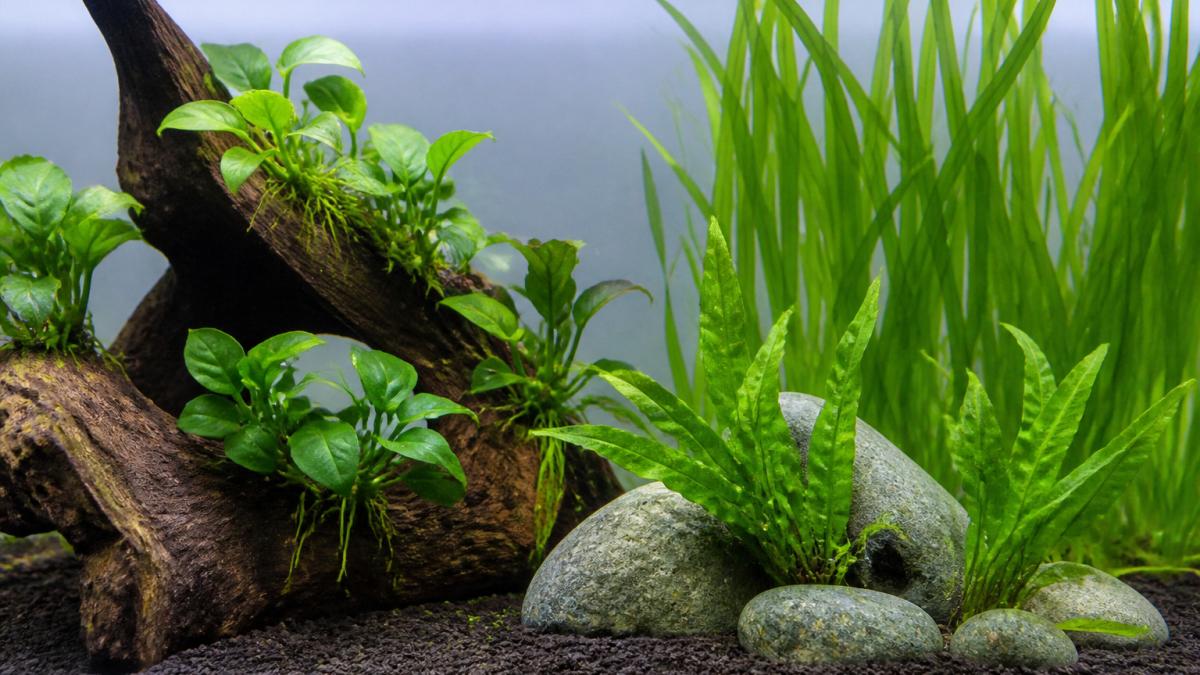
Anubias and Java Fern are epiphytic plants. Anubias do best when attached to hardscape like driftwood or stone, and Java Fern is best attached directly to hardscape.
Attaching Epiphytes to Hardscape
Anubias rhizomes must be kept above the soil, otherwise they will rot.
Instead, position the plant on a rock or piece of driftwood so the rhizome sits above the substrate. Use fishing line or plant-safe glue to hold it in place temporarily. Within a few weeks, the roots will anchor to the hardscape naturally, and you can remove the line.
Epiphytes absorb nutrients directly from the water column, so good water flow is key to keeping Anubias successfully.
Preventing Plant Melt on Arrival
Ohenrystanksalot has an Arrive-Alive Guarantee and a 7-day Thrive Policy. 85% of our plants are fully transitioned to aquatic environments.
Quick Comparison: Plant Size, Light, and Placement
| Plant | Mature Size | Light Requirement | Placement | Setup Type |
|---|---|---|---|---|
| Anubias Nana | 3-5 inches | Low-Medium | Foreground | Epiphyte on hardscape |
| Java Fern | 5 inches | Low-Medium | Midground | Epiphyte on hardscape |
| Hornwort | Up to 6 feet | Medium | Background/Floating | Stem plant, freestanding |
| Anubias Minima | 6-10 inches | Low-Medium | Midground-Background | Epiphyte on hardscape |
| Cryptocoryne Lutea | 4 inches | Low-Medium | Foreground-Midground | Root feeder in substrate |
| Amazon Sword | Up to 24 inches | Medium-High | Background/Centerpiece | Root feeder in substrate |
| Vallisneria | 12-20 inches | Medium-High | Background | Root feeder in substrate |
| Cryptocoryne Wendtii Lucens | 6-12 inches | Low-Medium | Midground-Background | Root feeder in substrate |
Ordering Your First Hardy Plants with Confidence
Buying plants online can feel risky, especially if you've had bad experiences before. Dead plants on arrival, melted leaves, or plants that never establish despite your best efforts, these are real frustrations.
Ohenrystanksalot offers insulated box shipping with heat or cold packs at no extra cost during extreme weather, same-day shipping for overnight orders, and an Arrive-Alive Guarantee.
Ohenrystanksalot offers a 7-day Thrive Policy and personalized support from real people.
Start with hardy species and use setup techniques suited to your plants.
Frequently Asked Questions
What are the easiest aquarium plants for beginners?
Anubias Nana ($4.50) is low maintenance, slow growing, and requires minimal light. Java Fern ($5.50) is hardy and adaptable. Hornwort is a beginner-friendly plant that can grow in a wide range of parameters, including temperature, pH, and lighting. Ohenrystanksalot grows plants without CO2, and 85% of its plants are fully transitioned to aquatic environments.
Can beginner aquarium plants grow without CO2?
Ohenrystanksalot grows plants without CO2. 85% of its plants are fully transitioned to aquatic environments.
What low light aquarium plants won't melt after planting?
Anubias Minima ($9.00) requires low to medium light and minimal maintenance. Cryptocoryne Lutea ($4.00) is slow growing and requires low to medium light. 85% of Ohenrystanksalot's plants are fully transitioned to aquatic environments.
How do I set up a beginner planted tank without special equipment?
Amazon Sword ($5.00) is a heavy root feeder and requires nutrient-rich substrate. Anubias do best when attached to hardscape like driftwood or stone, and Java Fern is best attached directly to hardscape. 85% of Ohenrystanksalot's plants are fully transitioned to aquatic environments.
Which hardy aquarium plants propagate easily for beginners?
Vallisneria plants send out runners that develop plantlets. Java Fern reproduces by growing small plantlets at the ends of each leaf, and can also be propagated by dividing the rhizome. Anubias can be propagated by cutting the rhizome between nodes, as long as each piece has its own roots and leaves.
Building a planted tank doesn't require expertise or expensive equipment. It requires the right plants and a seller who cares about your success. Shop all plants at Ohenrystanksalot and get your first hardy aquarium plants for beginners shipped with confidence.
