

How to Keep Aquarium Plants Alive in Your Tank?
Last Updated: October 30, 2026
Quick Summary
To keep aquarium plants alive, choose hardy beginner species, keep water temperature and pH stable, and match lighting to the plant so algae does not take over. Anubias and Java Fern tolerate low light and need stable conditions, not perfect ones, so start there.
- Most plants die because the environment changes too fast, not because the plant is weak.
- Start with hardy plants such as Anubias Barteri var. "Minima", Java Fern, or Cryptocoryne Lutea.
- Do smaller, regular water changes instead of occasional large ones to keep conditions steady.
- Begin with a 7-hour light timer and adjust one hour at a time, observing for two weeks.
- Do not bury Anubias or Java Fern rhizomes; attach them to driftwood or stone instead.
Table of Contents
- Why Aquarium Plants Die in the First Place
- Choosing Easy to Maintain Aquarium Plants for Beginners
- Setting Up Stable Water Quality, Temperature and pH
- Aquarium Plant Lighting Requirements and a Simple Schedule
- Feeding Plants: Substrate, Root Tabs and Fertilizer
- Acclimating New Plants and Avoiding Transplant Melt
- Aquarium Plant Maintenance Routine and Troubleshooting Symptoms
- Booking Your Plants: What to Order for Your Next Tank Setup
- Frequently Asked Questions
Why Aquarium Plants Die in the First Place
Most aquarium plants that die in a new tank don't die because the plant is weak. They die because the environment changes faster than the plant can adapt. Light, water temperature, and nutrients all shift, and the plant reacts by melting its leaves or stopping growth, which is why keeping aquarium plants alive depends on a stable setup.
Plants that are already fully transitioned to underwater life start with a better chance. Even so, the tank still has to be right. The most common causes are:
- Too much light too soon. Strong lighting feeds algae, which covers leaves and blocks growth.
- Sudden water changes. Large shifts in temperature or pH shock the plant.
- No nutrients. Plants in bare substrate slowly starve, even if the water looks clean.
A common mistake is blaming the plant when the real problem is the tank setup.
Choosing Easy to Maintain Aquarium Plants for Beginners
If you are new to planted tanks, start with hardy plants.
Anubias Barteri var. "Minima" (buy here) is a slow-growing plant with long, wavy leaves.

Microsorum Pteropus, "Java Fern" (buy here) is another hardy option.

Cryptocoryne Lutea (buy here) is slow growing and works in the foreground or midground.

Anubias is a common pick for beginners because it tolerates low light and is low maintenance.
Setting Up Stable Water Quality, Temperature and pH
Stability matters more than perfection, and it is the easiest way to keep aquarium plants alive long term. Plants handle a slightly imperfect pH far better than they handle swings from day to day.
Check these points regularly:
- Temperature: Keep it steady. Sudden jumps stress plants and speed up melt.
- pH and hardness: Know your tap water's baseline before you add plants, and avoid large corrections in one go.
- Water changes: Do smaller, regular changes instead of occasional large ones.
Watch out: Adding chemicals to force a pH change can shock new plants more than the water it was meant to fix.
Aquarium Plant Lighting Requirements and a Simple Schedule
Light is the throttle on plant growth, and it is also the most common reason a beginner tank turns green with algae. The goal is not maximum light, it is the least light that keeps your plants growing steadily without feeding algae. Low-light plants like Anubias and Java Fern grow well under modest lighting, so you do not need a high-output fixture to keep them alive.
Match the light level to the plant
Most beginner plants fall into three practical light tiers. Use these as starting points, not absolute rules, because fixture height, water depth, and surface agitation all change how much light actually reaches the leaves.
- Low light (roughly 6-8 hours at a modest output): Anubias, Java Fern, Java Moss, and most Cryptocoryne species. These tolerate shade and slow growth without melting.
- Medium light (roughly 7-8 hours at a moderate output): Amazon Sword, Vallisneria, and most stem plants. They grow faster and need more consistent feeding.
- High light (8+ hours at strong output): Carpet plants and red stem plants. These are not beginner plants and almost always require added carbon dioxide and steady fertilization to avoid algae.
If you are unsure which tier your fixture provides, start at the low end. It is far easier to add an hour of light than to recover from an algae bloom.
A measurable starting schedule
- Set a timer for 7 hours per day as your baseline.
- Keep the photoperiod in one uninterrupted block rather than split sessions, so plants get a consistent signal.
- Run the light at the same time every day, a $10 to $20 outlet timer removes human error.
- Observe for two weeks before changing anything. New plants need time to show whether they are adjusting.
How to adjust without guessing
Change one variable at a time and wait a week before the next change.
- If algae appears (green film on glass, fuzz on leaves, or green water), shorten the photoperiod by one hour and reduce fertilizer slightly before touching anything else.
- If growth stalls and leaves look pale, add one hour and watch for a week. If algae follows the extra hour, back it off.
- If plants grow well but algae also grows, the light duration is probably fine and the nutrient balance is off, see the feeding section below.
Light and carbon dioxide interact
In a low-tech tank without added carbon dioxide, light is the limiting factor, so more light does not always mean more growth, it often means more algae. In a tank with carbon dioxide injection, plants can use stronger light, but only if nutrients keep up. If you are not injecting carbon dioxide, stay in the low-to-medium range and choose plants that suit it.
Anubias Barteri var. "Minima" →
Signs your lighting is wrong
- Leaves stretching toward the surface with long gaps between nodes: too little light.
- Green film on glass within days of a water change: too much light or too many nutrients.
- Leaves bleaching or turning translucent at the top of the plant: light is too intense for that species.
lighting basics for planted tanks
Feeding Plants: Substrate, Root Tabs and Fertilizer
Plants feed in two ways. Root feeders draw nutrients from the substrate, while water-column feeders absorb them from the water. Knowing which type you have tells you where to put the food.
- Root feeders such as Cryptocoryne need nutrient-rich substrate or root tabs placed near the roots.
- Water-column feeders such as Anubias and Java Fern take nutrients from the water, so a liquid fertilizer works well.
Root tabs are useful in inert gravel or sand because they slowly release nutrients where the roots can reach them. Use them as directed and don't overdo it, since excess fertilizer feeds algae.
Acclimating New Plants and Avoiding Transplant Melt
New plants often lose leaves after planting. This is called transplant melt, and it is normal for many species.
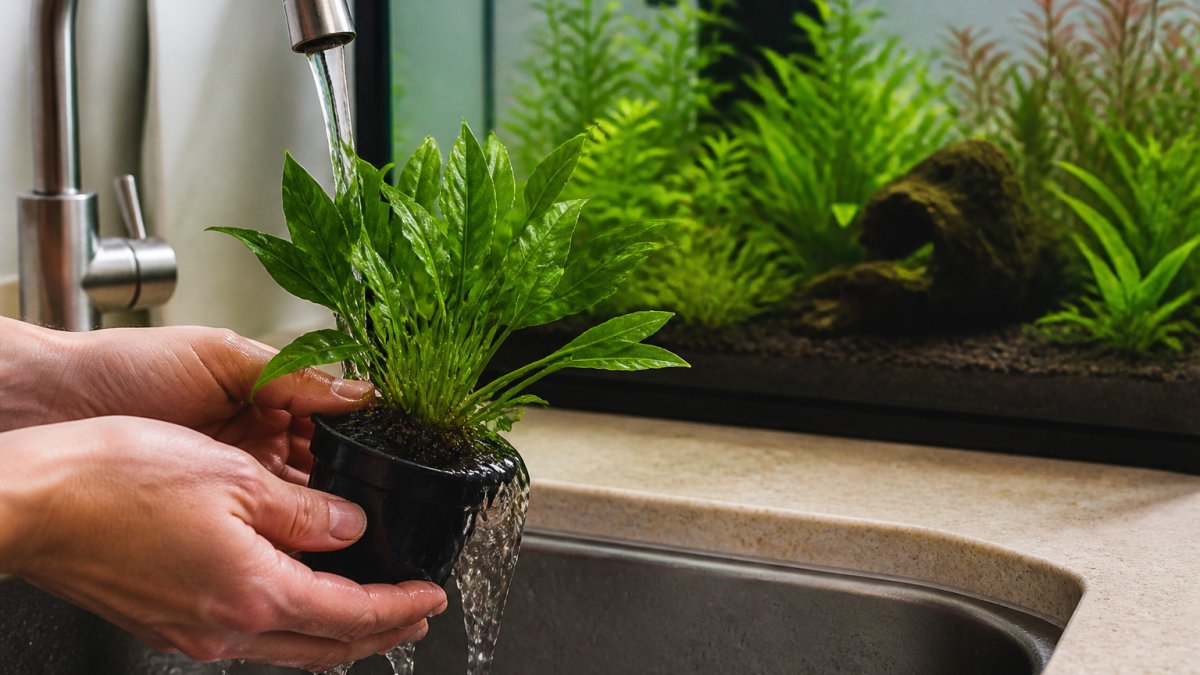
Hands gently rinsing a potted aquarium plant under a faucet beside a freshwater tank with healthy green plants.
Follow these steps when you add plants:
- Float the bag in the tank for 15-20 minutes to match temperatures.
- Slowly add a small amount of tank water to the bag over 30 minutes.
- Remove any damaged or dead leaves with clean scissors.
- Plant or attach the specimen according to its type.
- Expect some melt, and watch for new growth over the next two to three weeks.
Plants that arrive already transitioned usually skip the worst of this stage. You can order submersed-grown plants that are already adapted to underwater life.
Aquarium Plant Maintenance Routine and Troubleshooting Symptoms
A planted tank rewards routine more than it rewards intervention. Most problems are caught early by a five-minute weekly check, and most fixes are small adjustments rather than dramatic rescues. This section gives you a repeatable routine and a symptom-based diagnostic guide so you can tell nutrient problems, lighting problems, water-parameter stress, and normal transplant melt apart.
Weekly checklist (about 10 minutes)
- Inspect leaves on every plant. Remove yellow, brown, or melting leaves with clean scissors so they do not decay in the tank.
- Check for algae on glass, hardscape, and slow-growing leaves like Anubias. A little is normal; a film within days is a signal.
- Test water for temperature, pH, and, if you keep sensitive species, hardness. Note the readings so you can spot trends.
Monthly checklist (about 30 minutes)
- Perform a partial water change of roughly 20-30%, matching temperature and treating the new water.
- Dose fertilizer according to your schedule and the plant load. Note the date you placed root tabs so you can track when to replace them.
- Prune and replant fast-growing stems so light reaches lower leaves.
Symptom-based troubleshooting guide
Use the table below to match what you see to the most likely cause. Start with the cheapest, least disruptive fix and wait a week before changing anything else.
| Symptom | Most likely cause | First fix |
|---|---|---|
| Yellow or melting leaves within two to three weeks of planting | Transplant melt (normal for many species) | Remove damaged leaves, keep conditions stable, watch for new growth |
| Yellow leaves on older, lower leaves while new growth stays green | Nitrogen or potassium deficiency | Check fertilizer schedule; add a balanced liquid fertilizer |
| Small holes or pinpricks in older leaves | Potassium deficiency | Add a potassium-containing fertilizer |
| Pale or white new leaves | Iron or micronutrient deficiency | Use a fertilizer that includes micronutrients |
| Brown or black leaf edges | Water-parameter swings or low nutrients | Test pH and temperature; stabilize before adding fertilizer |
| Green film on glass and leaves | Too much light or excess nutrients | Shorten photoperiod by one hour; reduce feeding |
| Green water | Nutrient imbalance, often from overfeeding | Reduce feeding, shorten light, do a partial water change |
| Rotting rhizome on Anubias or Java Fern | Buried epiphyte | Lift the plant and attach the rhizome to hardscape |
| Stunted growth with no algae | Insufficient light or carbon dioxide | Add one hour of light; consider a low-tech-friendly plant swap |
| Leaves stretching with long gaps between nodes | Too little light | Increase photoperiod gradually |
Distinguishing melt from decline
Transplant melt usually appears on older, outer leaves within the first two to three weeks and is followed by new growth from the center or rhizome. A plant that is actually failing shows soft, foul-smelling tissue, a mushy rhizome, or no new growth after a month of stable conditions. If you see the latter, remove the plant before it fouls the water.
When to ask for help
If a symptom persists after two weeks of stable conditions and one careful adjustment, it is worth a second opinion. You can reach a real person by phone at Ohenrystanksalot for support.
Booking Your Plants: What to Order for Your Next Tank Setup
For a starter tank, a variety pack is the easiest way to get several beginner plants at once. If you have a smaller budget or tank, the smaller variety pack offers a compact alternative.
Plants shipped in fully transitioned condition give you the best start. Free overnight shipping applies to orders over $125, and same-day shipping is available for overnight orders.
Frequently Asked Questions
Why are my aquarium plants always dying?
Most aquarium plant die-off comes from a few repeatable causes: insufficient light for the species, unstable water temperature or pH, a substrate that lacks nutrients for root feeders, or plants that were not acclimated after shipping. Start by testing your water and checking the lighting schedule against the plant's recommended light level. Melting leaves after planting are usually a transition response, and most hardy plants recover within a few weeks if conditions stay stable. Changing several variables at once makes it hard to find the real cause, so adjust one thing at a time and watch for new growth.
What lighting do aquarium plants need to stay healthy?
Many beginner-friendly plants, including Anubias and Java fern, grow well under low to medium light. Cryptocoryne Lutea also does well at low to medium light. A practical starting point is 8 to 10 hours of light per day on a consistent timer, which supports growth without feeding excess algae. Plants stretch or pale when light is too weak, and algae often spreads when light runs too long or too intensely. Check each plant's recommended light level before you choose its position in the tank.
How often should I fertilize aquarium plants?
Most planted tanks do well with a light, regular dose of liquid fertilizer once or twice a week, paired with root tabs for plants that feed through their roots. Root feeders like Cryptocoryne benefit most from root tabs placed near the roots, while Anubias and Java fern take nutrients from the water column and rely more on liquid dosing. Adjust the amount based on plant growth and algae levels, since over-fertilizing causes as many problems as under-feeding. Water changes help replace nutrients and keep the balance steady.
How do I keep my aquarium water crystal clear for plants?
Clear water comes from a balanced setup rather than a single product. Keep filtration running continuously, perform regular partial water changes, and avoid overfeeding fish, since leftover food feeds cloudy bacterial blooms and algae. Make sure your substrate and plants are not decaying in the tank, and rinse new substrate before adding it. Test temperature, pH and hardness periodically so you can spot drift early. Stable conditions tend to produce clearer water and healthier plants at the same time.
Start with hardy plants, keep your light and water steady, and give new plants time to settle. Shop our full range of healthy aquatic plants and we will help you keep them alive.
