

How to Choose Plants for Nano Tanks: A 2026 Guide
Last Updated: October 24, 2026
Quick Summary
Plants for nano tanks should be slow-growing, low-tech species like Cryptocoryne Parva and Anubias that thrive without CO2 injection and tolerate the tight conditions of 3 to 10 gallon setups. Choose species that mature at 3-6 inches, match your lighting and water parameters, and plant sparsely to avoid nutrient competition and maintenance headaches.
- Cryptocoryne Parva and Anubias Barteri var. Nana are gold standard foreground plants that max out under 3-5 inches and need trimming only twice yearly
- Low-tech plants absorb nutrients from fish waste and water column without CO2 injection, keeping nano tanks stable and maintenance-light
- Start with 5-6 plants maximum spaced 1-2 inches apart; dense planting creates stagnant zones and nutrient competition in small volumes
- Nano tanks need 8-10 hours of moderate LED lighting daily at roughly 2-3 watts per gallon for non-CO2 plant growth
- Weekly 25-30% water changes at consistent temperature prevent plant melt and algae blooms that stress newly planted species
Table of Contents
- Understanding Nano Tank Plant Selection Basics
- Best Plants for Nano Tanks: Species That Thrive in Tight Spaces
- Nano Tank Plants Without CO2: Building a Low-Tech Setup
- Aquarium Plants for 5-Gallon Tanks: Sizing Your Selection
- How to Clean Aquarium Plants and Prevent Common Issues
- A Step-by-Step Framework for Choosing Your Nano Tank Plants
- Common Beginner Mistakes and How to Avoid Plant Melt
- Frequently Asked Questions
Understanding Nano Tank Plant Selection Basics
Choosing plants for nano tanks is fundamentally different from stocking a standard aquarium. Learn how to categorize aquatic plants by type before selecting species for your setup.
The core challenge isn't finding beautiful plants, it's finding plants that stay alive in confined spaces. Beginners underestimate how quickly small volumes accumulate waste and how sensitive compact ecosystems are to imbalance.
Why tank size matters for plant choice
Tank size dictates how plants behave.
Smaller tanks also limit hardscape and planting density. You can't install the same number of plants per gallon without creating a suffocating jungle, but fewer plants mean easier maintenance.
The WCAG guidelines on aquatic plant selection emphasize that species selection must account for container volume and growth patterns.
The advantage of low-tech, non-CO2 species
Low-tech plants are the foundation of successful nano tanks. They don't require injected CO2, specialized fertilizers, or high-end lighting, absorbing nutrients from the water column and surviving on ambient light.
Non-CO2 plants also grow slower, which sounds like a drawback but isn't. Slower growth means less trimming, less nutrient depletion, and more stable water parameters.
This approach removes the equipment barrier: no CO2 system, regulator, diffuser, or expensive fertilizer schedule.
Best Plants for Nano Tanks: Species That Thrive in Tight Spaces
The best plants for nano tanks fall into three placement categories: foreground, midground, and background. Each category serves a specific visual and functional role in your aquascape.
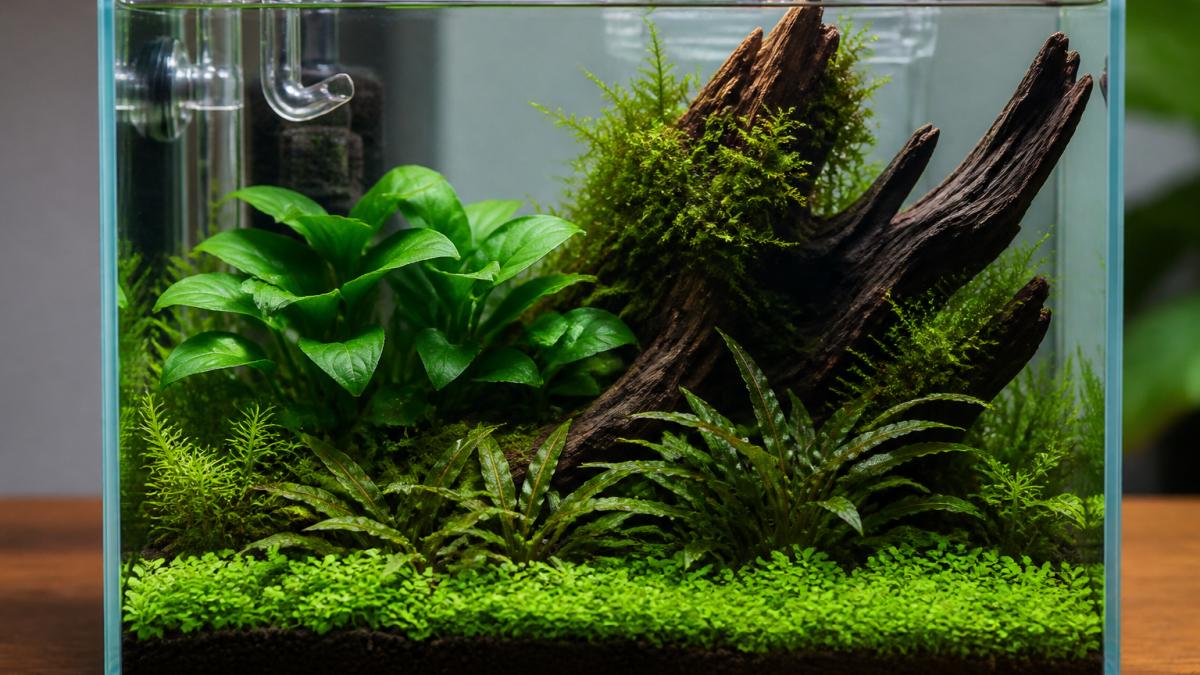
Foreground plants for nano aquascapes
Foreground plants create the visual foundation of your scape.
Cryptocoryne Parva is the gold standard foreground plant.

Anubias Barteri var. "Nana" is another foreground favorite, though it's a rhizome plant that should be attached to hardscape rather than buried.

Both thrive without CO2 and tolerate low to medium light, making them beginner-proof.
Midground and background options
Midground plants (3-6 inches) create depth and visual separation; background plants (6+ inches) fill the rear and sides. In nano tanks the distinction blurs, but the principle holds: taller plants back, shorter ones forward.
Anubias Barteri var. "Minima" works as midground or background depending on placement. At 6-10 inches it's taller than Nana but still compact, with long, slender, wavy leaves.
Other Cryptocoryne species work well too: Cryptocoryne Lutea stays around 4 inches and grows slowly, ideal for foreground or midground, while Cryptocoryne Beckettii var. Petchii reaches 4-6 inches with subtle red undersides.
The American Aquatic Plant Association guidelines on species compatibility recommend selecting plants with overlapping light and nutrient requirements to simplify care.
These recommended species thrive in nano tanks without CO2 and tolerate the tight conditions that challenge other plants.
| Plant Species | Placement | Key Trait |
|---|---|---|
| Cryptocoryne Parva | Foreground | Carpets slowly, needs trimming twice yearly |
| Anubias Barteri var. Nana | Foreground | Rhizome plant, must attach to hardscape |
| Anubias Barteri var. Minima | Midground/Background | Epiphyte with wavy leaves, attach to hardscape |
| Cryptocoryne Lutea | Foreground/Midground | Slow growth, low maintenance |
| Cryptocoryne Beckettii var. Petchii | Midground | Red undersides, slow growth |
| Vallisneria Nana | Background | Low-tech species, no CO2 needed |
Nano Tank Plants Without CO2: Building a Low-Tech Setup
The misconception that nano tanks require CO2 injection keeps many hobbyists from trying planted setups. The reality is the opposite: most nano tanks work better without CO2, since the equipment takes up valuable space and adds complexity.
Why CO2 injection isn't necessary
CO2 is a growth accelerant, not a requirement.
The plants we recommend, Anubias, Cryptocoryne, Vallisneria Nana, and mosses, evolved without pressurized CO2 and extract nutrients efficiently.
Low-tech setups also maintain more stable water parameters: no pH swings from injection, no regulator failures, no diffuser clogs. Stability is the nano tank's best friend.
Lighting and substrate requirements for non-CO2 growth
Lighting is the one area where you can't cheap out.
Substrate anchors roots and stores nutrients. Basic aquarium soil works for rooted plants like Crypts and Vallisneria, while rhizome plants like Anubias need only attachment to hardscape.
Keep water parameters stable: pH 6-7.5, temperature 72-78°F, moderate hardness. Weekly 25-30% water changes keep nitrate and phosphate in check without fertilizer dosing.
Aquarium Plants for 5-Gallon Tanks: Sizing Your Selection
A 5-gallon tank is the sweet spot for nano aquascaping: large enough for depth and layering, small enough for a beginner to manage. With roughly 20 liters of water, plant count is limited, which forces intentional design choices.
Mature size and growth rate considerations
The biggest mistake in nano tank planting is choosing species by how they look in the store, not at maturity.
Always check mature size before buying. For foreground coverage from a plant that maxes out at 6 inches, buy one or two stems and let them propagate via runners.
Growth rate affects maintenance too. Fast-growing stem plants demand weekly trimming and constant nutrient replenishment; slow-growing rhizomes like Anubias might need trimming every 2-3 months.
Planting density and spacing in compact volumes
Planting density is the ratio of plant biomass to water volume. A 5-gallon tank with 15-20 stems is heavily planted; 5-6 mixed plants is moderate.
A practical start: one foreground species (1-2 stems), one midground species (2-3 stems), and one background species (1-2 stems). That gives visual layering without overcrowding, and you adjust as plants propagate. Starting lean and adding later beats starting dense and removing plants.
Spacing affects water flow, and plants need circulation to absorb nutrients efficiently. Cramming too densely creates stagnant dead zones. Leave 1-2 inches between stems and clusters for noticeably healthier growth.
How to Clean Aquarium Plants and Prevent Common Issues
Algae on plant leaves is the most common problem in nano tanks, and it's preventable with proper cleaning technique and maintenance habits.
Safe cleaning techniques for delicate foliage
Most aquatic plants have delicate leaves that tear under direct pressure.
For rhizome plants like Anubias, gently rub leaves between your fingers while rinsing; the rhizome handles firmer pressure.
Prevention is best: maintain water parameters that discourage algae. Excess phosphate and nitrate fuel blooms, so weekly water changes and moderate fish stocking keep them in check.
Spotting and removing algae without damaging leaves
Green cloudy algae doesn't attach to leaves; it floats and gets removed during water changes.
For light coverage, a soft brush under running water removes most algae.
Rhizome plants resist algae naturally because their leaves are tough, and slow growers develop less algae since they produce less decaying leaf matter that triggers blooms.
A Step-by-Step Framework for Choosing Your Nano Tank Plants
Selecting plants shouldn't be random. A simple framework removes guesswork and leads to cohesive, maintainable scapes.
Step 1: Assess your tank dimensions and lighting
Start with numbers. Measure your tank's length, width, and depth in inches, and note your light type, wattage, and hours per day. This determines which plants are viable.
A 5-gallon tank with standard LED lighting (roughly 2-3 watts per gallon) supports any species we've discussed. A 3-gallon with the same lighting is tight for background plants, so prioritize foreground and midground. A 10-gallon with high-end lighting opens more options, but our recommended species still work best.
The Aquatic Gardeners Association resources on nano tank setup provide detailed lighting recommendations by tank size. Consult these before finalizing your light choice.
Step 2: Match water parameters to plant needs
Test your water before buying plants. Most kits measure pH, hardness, nitrate, and phosphate. Our recommended species tolerate pH 6-7.5, soft to moderately hard water, and moderate nutrients, but knowing your baseline prevents surprises.
Soft and acidic tap water is fine; hard and alkaline is also fine. The key is stability. Plants adapt to consistent conditions and struggle with fluctuation, so stable hard water beats unstable soft water.
Step 3: Plan foreground, midground, and background placement
Sketch your scape on paper or in an aquascaping app. Mark where hardscape (driftwood, rocks) goes, then assign plant zones: foreground in front, visible from the front glass; midground behind foreground but in front of background; background filling the rear and sides.
In a 5-gallon tank, you might have just one foreground zone, one midground zone, and a small background area. That's fine. Simplicity is strength in nano tanks.
Step 4: Account for growth and maintenance time
Estimate your weekly time. Heavily planted tanks with fast growers demand 1-2 hours weekly for trimming, dosing, and maintenance.
Limited time? Choose slow growers and plant sparsely. Enjoy hands-on maintenance? Plant more densely.
When you're ready to stock your nano tank, the Plants collection at Ohenrystanksalot includes all the species we've discussed.
Common Beginner Mistakes and How to Avoid Plant Melt
Plant melt, the rapid deterioration of newly planted species, is the biggest reason beginners quit planted tanks.
The second mistake is planting too densely and creating nutrient competition.
The third mistake is inconsistent water parameters. Water changes that swing pH or temperature stress plants.
The fourth mistake is underestimating algae prevention.
Choosing plants for nano tanks comes down to matching species to constraints. The species we've covered, Cryptocoryne Parva, Anubias Nana, Vallisneria Nana, and their relatives, thrive in nano tanks because they're adapted to low-tech conditions and slow growth.
When you're ready to start, Ohenrystanksalot's fully transitioned plants arrive ready to plant.
Frequently Asked Questions
Can you grow aquarium plants in a nano tank without CO2?
Yes. Many aquarium plants thrive in nano tanks without injected CO2, especially slow-growing species like Anubias Nana ($4.50), Cryptocoryne Parva ($3.00), and moss varieties. These plants absorb nutrients from the water column and benefit from good lighting and water flow. Low-tech plants are actually ideal for nano tanks because they grow slowly, require minimal maintenance, and won't quickly outgrow your limited space. Ohenrystanksalot specializes in non-CO2 plants that are fully transitioned to aquatic life, so they adapt immediately without melting.
What are the best types of plants for an aquarium nano tank?
The best nano tank plants are compact, slow-growing species suited to small volumes. Foreground options include Cryptocoryne Parva and Anubias Nana Petite. Midground choices include Anubias Minima and Cryptocoryne Lutea. Moss species like Fissidens fontanus work well attached to hardscape. These plants are beginner-friendly, require low to medium light, and stay under 6 inches at maturity. Epiphytic plants like Anubias should be tied to driftwood or rock rather than planted in substrate to prevent rhizome rot.
How do you clean aquarium plants safely?
Clean aquarium plants gently using a soft brush or your fingers under flowing tank water. Remove visible algae by rubbing leaves carefully, working from the stem outward. For plants attached to hardscape, brush the wood or rock rather than the leaves themselves. After cleaning, rinse any debris from the plant before returning it to the aquarium. Regular water changes and good water circulation prevent heavy algae buildup and reduce cleaning needs.
Which plants stay small enough for a nano tank?
Dwarf and mini plant varieties are essential for nano tanks. Anubias Nana matures at 3-5 inches, Cryptocoryne Parva stays under 3 inches, and Anubias Minima reaches 6-10 inches. Moss species have no set height and can be trimmed to fit. These compact plants won't overcrowd your tank and allow room for hardscape and livestock. Check mature size before buying, as even 'small' plants can outgrow a 5-gallon space if they're actually medium-sized species.
What lighting do nano aquarium plants need?
Most beginner-friendly nano plants thrive under low to medium light, typically 8-10 hours per day. Anubias and Cryptocoryne species don't need intense lighting and actually prefer shade. Standard LED aquarium lights rated 20-40 watts are sufficient for 5-gallon tanks. Avoid high-intensity lighting unless you're growing demanding stem plants, which usually require CO2. Consistent lighting duration matters more than brightness; use a timer to maintain a regular photoperiod.
How many plants should you put in a nano aquarium?
Plant density depends on your goal and tank size. For a 5-gallon nano tank, start with 3-5 plants of varying heights to create depth without overcrowding. Foreground plants should cover 30-40% of the substrate, midground plants 20-30%, and background plants 10-20%. Leave space for hardscape and fish movement. It's easier to add plants later than remove overgrowth, so begin conservatively. Slow-growing species like Anubias and crypts won't quickly overwhelm small volumes.
What can I keep in a nano aquarium?
Nano aquariums support small fish like bettas, rasboras, or nano tetra species, along with shrimp and snails. Plant selection depends on your livestock; herbivorous fish may uproot or eat softer plants, so choose hardy species like Anubias (which fish rarely eat) or tie plants to hardscape. Epiphytic plants attached to driftwood are safer from disturbance. Ensure your plant choices don't compete with fish for space or create hiding spots that stress your animals.
