

7 Easy Foreground Plants for Your Freshwater Aquarium
Last Updated: October 26, 2026
Quick Summary
The easiest foreground plants for a freshwater aquarium are Cryptocoryne Parva and Dwarf Sagittaria, the only two on our list that genuinely carpet. Both tolerate modest lighting and grow without injected CO2, though Parva is slow and Dwarf Sagittaria needs medium light to stay low.
- Cryptocoryne Parva stays under three inches and handles low, medium, or high light.
- Dwarf Sagittaria spreads fastest but stretches leggy and can reach a foot under low light.
- Keep Anubias Nana rhizomes above the substrate, tied or glued to rock or driftwood.
- Expect new plants to sit still for two to three weeks before showing top growth.
- Space runner plugs 1-2 inches apart and rosettes 2-3 inches apart when planting.
Table of Contents
- Why Easy Foreground Plants Make or Break a Freshwater Aquarium
-
7 Easy Foreground Plants for a Freshwater Aquarium
- 1. Cryptocoryne Parva: The Any-Light Carpet Crypt
- 2. Sagittaria Subulata "Dwarf": The Fast-Spreading Runner
- 3. Anubias Barteri var. "Nana": The Epiphyte That Never Melts
- 4. Cryptocoryne Lutea: Slow, Steady, and Shade-Tolerant
- 5. Cryptocoryne Beckettii var. Petchii: A Hint of Pink Up Front
- 6. Ludwigia Repens "Narrow Leaf": The Versatile Stem Plant
- 7. The Non-Carpet Option: Hardscape and Moss Alternatives
- Easy Aquarium Carpet Plants: Which Ones Actually Spread
- Low-Light Foreground Aquarium Plants for Nano and Shrimp Tanks
- Aquarium Plants That Grow Without CO2: What to Expect
- How to Grow Carpet Plants in Aquarium Substrate
- Troubleshooting: Why Foreground Plants Fail in Their First Month
- Shop Easy Foreground Plants for Your Next Aquascape
- Frequently Asked Questions
Why Easy Foreground Plants Make or Break a Freshwater Aquarium
The foreground is the first thing anyone notices in a planted tank.
Here is the part most guides skip: a foreground plant rarely fails because it is difficult to grow. It fails because it was grown above water and forced to rebuild itself underwater in your tank.
At Ohenrystanksalot, we ship plants that have already made that transition, so the plant you unwrap is the plant that stays.
7 Easy Foreground Plants for a Freshwater Aquarium
These seven picks share three traits: they tolerate modest lighting, they do not demand injected CO2, and they stay low enough for the front of the tank. We list them from smallest and slowest to tallest and fastest.
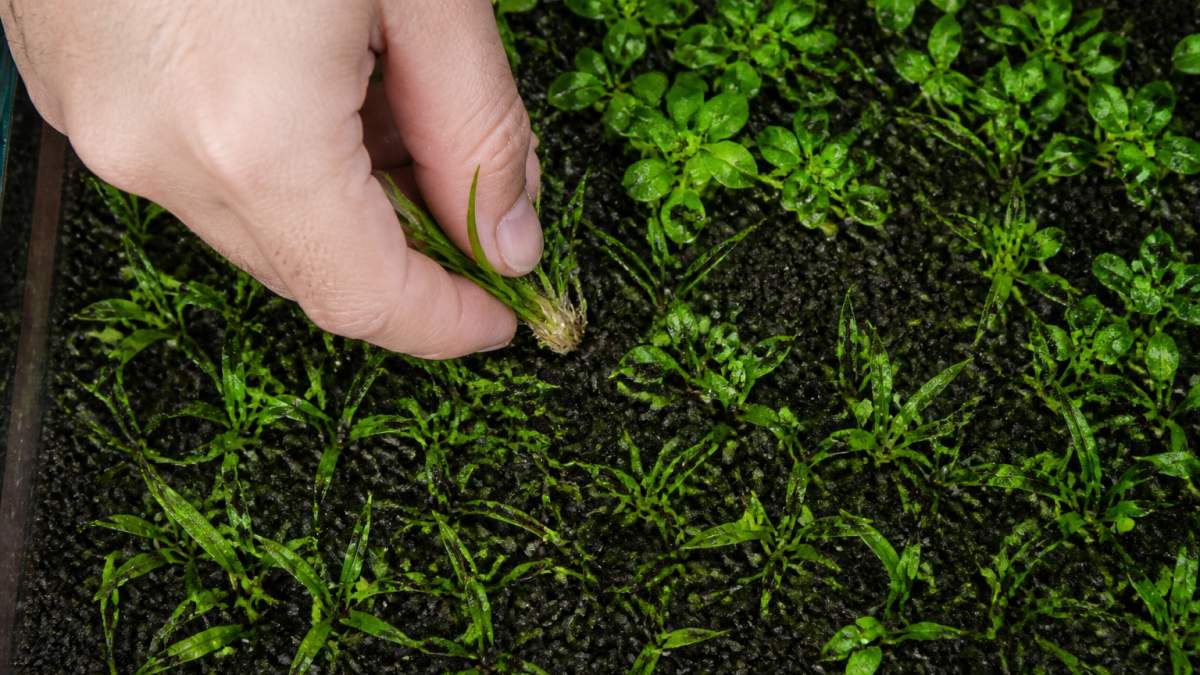
1. Cryptocoryne Parva: The Any-Light Carpet Crypt
Cryptocoryne Parva is the smallest crypt commonly sold, maturing under three inches, and the most forgiving carpeting plant on this list. It handles low, medium, or high light, tolerates many temperatures and pH, and stays compact without trimming.
It is slow: a Parva carpet takes months, not weeks, which is the trade-off for a plant that almost never melts.
Best for: low-tech tanks that want a true carpet without high light. Skip if: you want full coverage within a month.
You can shop Cryptocoryne Parva and check current availability.

2. Sagittaria Subulata "Dwarf": The Fast-Spreading Runner
Dwarf Sagittaria is the fastest way to a green carpet with the fewest starter plants.
The catch is light. Under medium to high light it stays bushy at two to six inches; under low light it stretches leggy and can reach a foot in blade length, ruining the foreground look.
Best for: beginners who want visible progress fast. Skip if: your fixture is genuinely low output.
Shop Sagittaria Subulata "Dwarf" to start a runner-based carpet.

3. Anubias Barteri var. "Nana": The Epiphyte That Never Melts
Anubias Nana is not a carpet plant and should not be sold as one. It is a low, deep-green rosette that grows tightly around its rhizome and sits beautifully wedged between rocks at the front of the scape.
The rule that matters: keep the rhizome above the substrate, because a buried rhizome rots. Tie or glue the plant to driftwood or stone instead, where it feeds from the water column and needs decent flow.
Shop Anubias Barteri var. "Nana" for hardscape-based foreground coverage.

4. Cryptocoryne Lutea: Slow, Steady, and Shade-Tolerant
Cryptocoryne Lutea grows thin, reed-like leaves mostly vertically, reaching about four inches. It wants low to medium light and a nutrient-rich substrate, though it will grow in inert gravel with root tabs.
This is the pick for a nature-style aquarium where the foreground should look natural rather than manicured. It sends runners over time and can eventually form a loose carpet, but expect a cluster of small plants first.
5. Cryptocoryne Beckettii var. Petchii: A Hint of Pink Up Front
Petchii reaches four to six inches and carries a pinkish flush on new leaves, rare in a low-light foreground plant. It handles low to medium light and feeds from its roots, so root tabs matter more than water-column dosing.
Give it a stable spot and leave it alone. Crypts dislike being moved, and Petchii is no exception: replanting it repeatedly sets it back each time.
Order Cryptocoryne Beckettii var. Petchii if you want color without high light.
6. Ludwigia Repens "Narrow Leaf": The Versatile Stem Plant
Narrow Leaf Ludwigia is technically a stem plant that can reach 12 to 18 inches, but frequent pruning keeps it short enough for foreground and midground duty.
It dislikes fine sand and prefers a nutritious soil. Trim above a node and replant the cutting; each trim typically pushes one or two side shoots, which thickens the group.
Shop Ludwigia Repens "Narrow Leaf" for a colorful, fast-growing option.
7. The Non-Carpet Option: Hardscape and Moss Alternatives
Not every foreground needs to carpet. A strip of dark substrate framed by stone, with small Anubias and moss patches tucked into the gaps, reads as intentional and needs almost no maintenance.
This approach suits shrimp tanks especially well: the moss holds biofilm that shrimp graze on, and the open substrate gives bottom feeders room to work. It also sidesteps the two hardest parts of carpeting: light intensity and patience.
Easy Aquarium Carpet Plants: Which Ones Actually Spread
Only two plants on this list genuinely carpet: Cryptocoryne Parva and Dwarf Sagittaria. Both spread by runners under the substrate rather than by seed or fragmentation.
| Plant | Spreads Into Carpet | Speed | Light Needed |
|---|---|---|---|
| Cryptocoryne Parva | Yes, slowly | Slow | Any |
| Dwarf Sagittaria | Yes, fast | Fast | Medium-high |
| Cryptocoryne Lutea | Eventually, loose | Slow | Low-medium |
| Cryptocoryne Petchii | Clumps, not carpet | Slow | Low-medium |
| Anubias Nana | No | Very slow | Low-medium |
| Ludwigia Narrow Leaf | No, but fills in | Fast | Medium |
If a carpet is the goal, pick one of the top two and commit. Mixing a slow crypt with a fast runner in the same patch usually ends with the runner smothering the crypt.
Low-Light Foreground Aquarium Plants for Nano and Shrimp Tanks
Low-light foreground plants are the safest choice for nano tanks and shrimp setups, where a strong fixture often causes algae before it helps plants.
Shrimp tanks reward a different layout than fish tanks.
One caveat: low light slows everything, including recovery. Expect new plants to sit still for two to three weeks before showing growth. That is normal, not failure.
Aquarium Plants That Grow Without CO2: What to Expect
Every plant on this list will survive and spread without injected CO2, but "survives without CO2" and "thrives without CO2" are different claims. The table below separates the two so you can set realistic expectations before you buy.
| Plant | Low-Tech Verdict | Realistic Spread Rate (No CO2) | Light Range | Temp Range | Substrate |
|---|---|---|---|---|---|
| Cryptocoryne Parva | Thrives | Slow: 3-6 months to fill a 12 in patch | Low to high | 72-82°F | Nutrient-rich; root tabs help |
| Dwarf Sagittaria | Thrives under medium light; tolerates low | Fast: runners within 4-8 weeks | Medium to high (stretches in low) | 70-82°F | Any; root tabs optional |
| Anubias Nana | Thrives | Very slow: one new leaf every 3-6 weeks | Low to medium | 72-82°F | Attached to hardscape, not buried |
| Cryptocoryne Lutea | Thrives | Slow: loose carpet in 4-6 months | Low to medium | 72-82°F | Nutrient-rich; root tabs recommended |
| Cryptocoryne Petchii | Thrives | Slow: clumps widen over months | Low to medium | 72-82°F | Nutrient-rich; root tabs recommended |
| Ludwigia Repens "Narrow Leaf" | Tolerates; color muted | Fast: needs pruning every 2-3 weeks | Medium to high for color | 70-82°F | Nutrient-rich soil; dislikes fine sand |
What actually changes without injection:
- Carpeting timelines stretch. A Parva carpet that might fill in over two months with CO2 typically takes four to six months without it. Dwarf Sagittaria is the exception; it still runs quickly under medium light.
- Color fades on stems and Petchii. Red and pink tones depend on light intensity and available carbon. Without injection, expect green-to-bronze rather than vivid pink.
- Melt risk drops. Plants grown without CO2 arrive adapted to low-carbon conditions, so the shock of moving into a non-injected tank is smaller. This is the main reason low-tech tanks lose fewer plants in month one.
Beginners often buy a plant labeled "easy" and expect carpet coverage in a month. The honest expectation for a genuinely low-tech tank is a filled foreground in one season, not one month, with Dwarf Sagittaria as the only fast exception.
The Aquatic Plant Central plant database is a useful cross-reference for species requirements, and the U.S. Fish and Wildlife Service publishes guidance on aquatic species and transport rules worth checking before ordering across state lines.
How to Grow Carpet Plants in Aquarium Substrate
Most carpet failures happen in the first ten minutes of planting, not in month two. The steps below cover portion size, spacing, depth, and the first-month support that determines whether a carpet fills in or washes out.
Before you plant:
- Match substrate depth to the plant. Aim for 2-3 inches of aquasoil or soil capped with gravel at the front of the tank. Crypts and Ludwigia root deeply; a thin gravel layer starves them.
- Strip the rock wool completely. Rinse the roots under room-temperature water and tease them apart with your fingers. Leaving rock wool packed around the crown invites rot.
- Divide into plugs roughly the size of a thumbnail. A single pot of Cryptocoryne Parva typically yields 8-12 plantable plugs; Dwarf Sagittaria yields 5-8. More, smaller plugs fill faster than a few large clumps.
Planting:
- Use straight tweezers at a 45-degree angle. Grip the plant just above the roots, push into the substrate, and open the tweezers slightly as you withdraw so the substrate closes around the roots.
- Leave the crown just above the substrate line. For crypts and Sagittaria, the crown, where leaves meet roots, should sit at or barely above the surface. Burying it rots the plant within one to two weeks.
- Space plugs 1-2 inches apart for runners, 2-3 inches for rosettes. Runners from Dwarf Sagittaria and Parva travel under the substrate and meet in the middle; tighter spacing speeds coverage but risks competition.
- Keep Anubias rhizomes above the substrate entirely. Tie or glue the rhizome to stone or driftwood. A buried rhizome turns soft and brown and does not recover.
First-month support:
- Add root tabs at planting time for crypts and Ludwigia, pressed 2-3 inches into the substrate near the roots. Re-dose every 2-3 months per the product label.
- Keep the front glass clear of tall plants and hardscape shadows so light reaches the substrate edge. A tall tank with a weak fixture lights the top and leaves the foreground dim.
- Weight new plugs with a small stone if you keep bottom feeders or cichlids that dig. Remove the stone once roots grip, usually in two to three weeks.
- Trim runners that climb above your target height and replant the cuttings to fill gaps. Dwarf Sagittaria responds well to shears; Parva rarely needs trimming.
Expect new plants to sit still for two to three weeks before showing top growth. That pause is root establishment, not failure, leave the plants in place and resist the urge to replant.
Troubleshooting: Why Foreground Plants Fail in Their First Month
Most foreground plant failures in the first month trace to one of four fixable causes.
- Melt after planting. Crypts and Sagittaria often drop older leaves after being moved. Leave the roots alone and new growth usually appears within two to three weeks.
- Uprooting by fish. Bottom feeders and cichlids dig. Plant heavier plugs, or weight them with a small stone until roots take hold.
- Light starvation at the substrate. A tall tank with a weak fixture lights the top and shadows the front. Raise the light or choose Parva or Anubias instead.
A common mistake is tearing out a melting plant too early. Crypt melt looks dramatic, but the root system is usually fine, and replanting just restarts the clock.
Shop Easy Foreground Plants for Your Next Aquascape
Building a foreground that holds up takes the right species and a supplier who ships plants already adapted to underwater life. That is the whole idea behind Ohenrystanksalot: fully transitioned plants grown without CO2, same-day shipping on overnight orders, insulated boxes with heat or cold packs at no extra cost, and free overnight shipping on orders over $125.
Get started with Ohenrystanksalot and plant a foreground that stays green from the first week.
Frequently Asked Questions
What are the easiest foreground plants for a freshwater aquarium?
Cryptocoryne Parva, Dwarf Sagittaria, and Anubias Nana are the three most forgiving choices for beginners. Crypt Parva tolerates any light level and stays under 3 inches, Dwarf Sag spreads quickly via runners in medium to high light, and Anubias Nana attaches to rock or driftwood and needs only low light. All three are slow or moderate growers that tolerate missed water changes and don't demand injected CO2.
Which foreground plants can grow without CO2 injection?
Every plant in this guide grows without CO2, but the ones that handle it best are Cryptocoryne Parva, Cryptocoryne Lutea, Anubias Nana, and Cryptocoryne Petchii. These are root feeders and epiphytes that draw nutrients from substrate and water column rather than depending on fast carbon uptake. Expect slower growth than a CO2-injected tank, roughly half the spread rate, but the plants stay healthy and compact.
Can foreground plants grow in gravel?
Yes, with caveats. Root feeders like Cryptocoryne and Dwarf Sagittaria will grow in gravel, but they need root tabs because plain gravel holds almost no nutrients. Anubias Nana is the easiest in gravel because it isn't planted at all: you tie or glue the rhizome to a stone or piece of driftwood. Avoid fine sand for stem plants like Ludwigia, which the listing notes it dislikes.
How long does it take aquarium carpet plants to spread?
Dwarf Sagittaria is the fastest, filling a 20-gallon footprint in roughly two to three months under medium to high light. Cryptocoryne Parva and Cryptocoryne Lutea take much longer, often six months or more, because they spread slowly through runners. Anubias Nana doesn't carpet at all; it grows outward from its rhizome at a few inches per year.
Do foreground plants need special substrate?
Not always, but it helps. Nutrient-rich aquasoil gives root feeders like Cryptocoryne Petchii and Cryptocoryne Lutea the best start. In inert gravel or sand, add root tabs every two to three months. Epiphytes like Anubias Nana should never be buried, since a buried rhizome rots. Attach it to hardscape instead and let it feed from the water column.
