

Buceplant vs Aquarium Plants Factory: Which Is Right for You
Table of Contents
- What to Look for When Buying Aquarium Plants Online
- Buceplant Reviews: Plant Selection, Quality, and Shipping
- Aquarium Plants Factory Reviews: Availability, Pricing, and Guarantees
- Low-Tech Aquarium Plants: Which Supplier Supports Beginners Better
- How to Acclimate Aquarium Plants After Shipping
- Plant Condition on Arrival: Packaging, Transit Time, and Guarantees
- Making Your Choice: Key Differences and Recommendations
- Frequently Asked Questions
Last Updated: October 14, 2026
What to Look for When Buying Aquarium Plants Online
When comparing buceplant vs aquarium plants factory, three things separate a good aquatic plant buying experience from a frustrating one: plant quality on arrival, how well the supplier understands beginners, and whether their guarantee means something.
Plant selection matters, but not the way you'd think. A massive catalog sounds impressive until half the plants arrive stressed or melted.
What separates a reliable supplier from a frustrating one:
- Plant transition status: Are plants already adapted to aquatic life, or will they melt in your tank within days?
- Shipping method: Does the supplier use insulated boxes with temperature packs during extreme weather, or just standard cardboard?
- Arrival guarantee: What happens if plants arrive damaged or dead? A real guarantee has teeth, not just a promise.
- Customer support: Can you actually talk to a human if something goes wrong, or are you stuck with automated responses?
- Plant selection depth: Do they stock beginner-friendly species, or mostly advanced aquascaping plants?
The buceplant vs aquarium plants factory comparison comes up because both are established names. The real question isn't which is bigger, it's which matches your needs.
Buceplant Reviews: Plant Selection, Quality, and Shipping
Buceplant has built a reputation for variety, spanning common beginner plants to rare specialty species for aquascapers hunting specific cultivars.
However, variety doesn't guarantee quality. Many buyers report Buceplant orders arrive with mixed condition, some thriving, others stressed from transit. That inconsistency is the trade-off for their high-volume model.
Shipping with Buceplant typically takes 2-3 business days.
Their guarantee exists, but claims can be bureaucratic: photos, order details, and documentation, which means time troubleshooting instead of enjoying your tank.
Buceplant Pros:
- Extensive plant species availability
- Established reputation in the hobby
- Competitive pricing on bulk orders
- Good for experienced aquascapers who know exactly what they want
Buceplant Cons:
- Inconsistent plant arrival condition
- Limited climate protection during shipping
- Claim process requires documentation and patience
- Hit-or-miss customer support responsiveness
Aquarium Plants Factory Reviews: Availability, Pricing, and Guarantees
Aquarium Plants Factory (APF) positions itself as a high-volume supplier with aggressive pricing: move inventory quickly, keep costs low, pass savings to buyers.
Their selection is solid for common species but thin on specialty items, you'll find Java fern, Anubias, and Ludwigia, but fewer rare cultivars.
Shipping is fast, typically 1-2 business days, but speed without proper conditioning creates risk: plants arrive quickly but not always in great shape.
Their guarantee looks lenient on paper, a 14-day live arrival promise, but the fine print matters.
Aquarium Plants Factory Pros:
- Aggressive pricing on common plants
- Fast shipping times
- Lenient arrival window for claims
- Good for budget-conscious beginners
Aquarium Plants Factory Cons:
- Limited specialty plant availability
- Basic packaging without climate control
- Return shipping costs reduce refund value
- Plant conditioning is inconsistent
The Cost Math Most Comparisons Skip
Most write-ups stop at "APF is cheaper." That's not useful at checkout.
Step 2, Record the listed price per plant, not the bundle price. Bundle pricing hides per-unit cost.
Step 3, Add shipping at the real threshold. Both suppliers use free-shipping minimums that change.
Step 4, Add climate protection if it isn't included. Insulated boxes and heat or cold packs are often a paid add-on.
Step 5, Add the cost of a failed plant. Almost nobody does this.
Stock Availability by Plant Type
Price only matters if the plant is in stock. Availability differs by category:
- Beginner-friendly rosettes and rhizomes (Anubias, Java fern, Bolbitis): usually well stocked by both. This is where APF's pricing advantage is most visible.
- Stem plants (Ludwigia, Rotala, Bacopa): both carry them, but APF's selection leans toward the common green and red varieties rather than named cultivars.
- Carpeting species (Monte Carlo, dwarf hairgrass, dwarf baby tears): availability swings with season and grow-out cycles. Check whether the listing is a pot, a mat, or a tissue-culture cup, the format changes both price and how much you actually receive.
- Tissue-cultured plants: these are the cleanest option for pest-free starts, but they arrive small and need a transition period. Not every supplier stocks them consistently.
- Rare and collector species (Bucephalandra cultivars, unusual Cryptocoryne): this is where APF thins out. If you're hunting a specific cultivar, expect to look elsewhere.
Low-Tech Aquarium Plants: Which Supplier Supports Beginners Better
For your first planted tank, you don't need rare or advanced species, you need hardy, forgiving plants that thrive without CO2 injection, fertilizer dosing, or complex lighting.
Buceplant carries low-tech options, but you have to filter through their catalog to find them, the sheer volume of specialty items can overwhelm newcomers.
Aquarium Plants Factory focuses more on low-tech species by default, which aligns with beginner needs, but inconsistent conditioning means even "hardy" plants may arrive stressed.
The best low-tech supplier pre-conditions plants to aquatic life and grows them without CO2 dependency, so they adjust immediately instead of melting.
How to Acclimate Aquarium Plants After Shipping
Acclimation takes 30 minutes to an hour and prevents shock.
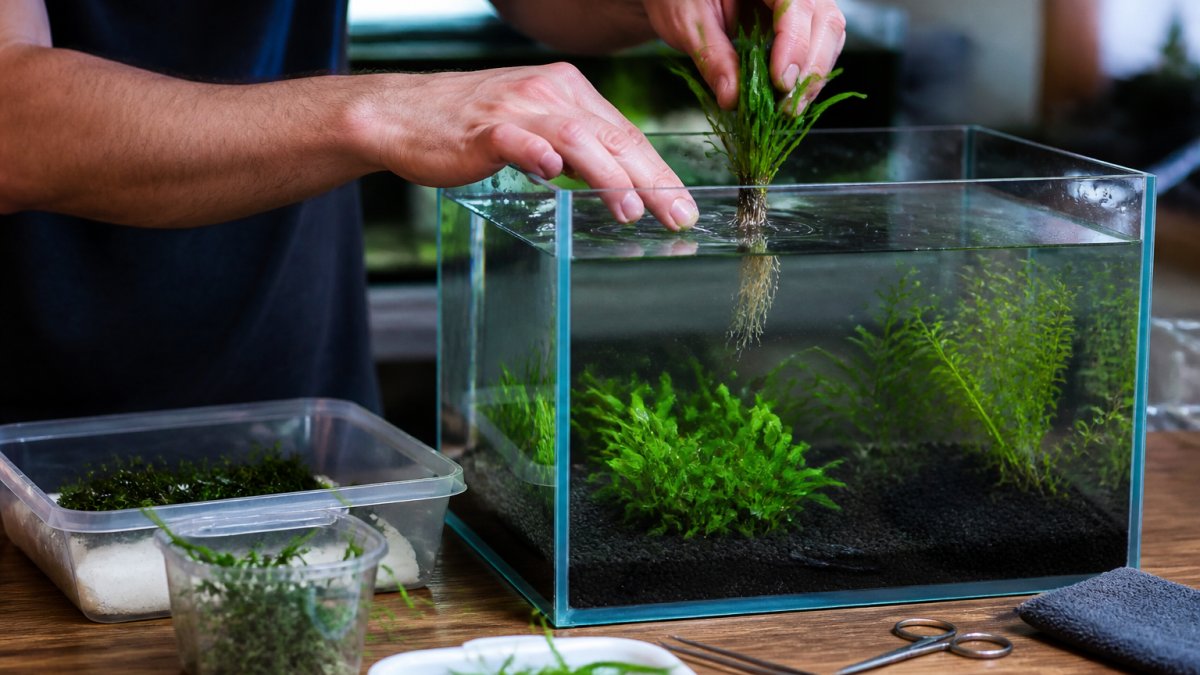
Next, place the plants in a container of aquarium water for 15-20 minutes to prevent osmotic shock.
Finally, plant them in your substrate or attach them to hardscape. Don't bury stem plants too deep, just anchor the roots.
The key insight most guides miss: acclimation doesn't fix plants that arrived in poor condition.
Plant Condition on Arrival: Packaging, Transit Time, and Guarantees
This is the make-or-break factor for online plant orders. You can't inspect plants before buying, so you're trusting the supplier's shipping method and guarantee. Here's a repeatable way to judge it yourself.
Run Your Own Arrival Test
You don't need a lab, just a consistent method so order one and order two are judged the same way:
- Order a comparable cart. Same species, same pot or cup size, same week if possible. Different plants melt at different rates, so comparing a hardy Anubias to a delicate carpeting species tells you nothing.
- Photograph the unopened box. Note its condition, whether insulation is present, and whether a heat or cold pack is included, your baseline evidence if you file a claim.
- Photograph each plant on a white surface within one hour of opening. Same lighting, same distance, the only fair way to compare across orders.
- Score each plant 1-5 on four criteria: leaf color (yellowing or browning), turgidity (firm vs. limp), root or rhizome condition, and melt or damage. Total the four scores per plant, then average across the order.
- Re-check at day 3 and day 7. A plant that looks fine on arrival but melts by day 3 is a shipping-stress problem, not an acclimation problem.
- Count order accuracy separately. Wrong species, missing items, and substituted sizes are fulfillment errors, not condition errors. Track them separately.
Don't judge condition on day one alone. The most useful signal is the day-3 to day-7 change. A plant that holds steady is well conditioned; a plant that declines is telling you about transit stress.
What Transit Time Actually Does
Plants can survive three to four days in a box, but they're stressed by day two. Anything longer than four days significantly increases melt risk, especially for sensitive species. Both suppliers ship within acceptable timeframes, but neither guarantees climate protection automatically.
Packaging determines whether plants survive temperature extremes. Standard cardboard offers no insulation. When ambient temperature drops below roughly 50°F or exceeds roughly 85°F, uninsulated shipments put plants at serious risk. Insulated boxes with heat or cold packs cost more, but they're the difference between arrival and dead-on-arrival.
Guarantee Mechanics, Side by Side
A guarantee is only as good as its claim process. Compare these four things before you buy:
- Reporting deadline. A 24-hour window is tight if you work away from home or the box sits on a porch. A multi-day window gives you room to inspect properly.
- Evidence required. Photos of the plant, the packaging, and the packing slip are standard. Ask whether a photo of the unopened box is required.
- Remedy. Replacement, store credit, and refund are not the same thing. Replacement keeps you in the hobby; a refund leaves you starting over.
- Who pays return shipping. If you pay to send a dead plant back, the "free replacement" isn't free. This is the most common hidden cost in plant guarantees.
The strongest guarantee is the one with a clear deadline, simple evidence requirements, a replacement remedy, and no return-shipping cost to you. Read the policy page before you order, not after something dies.
Why Conditioning Beats Acclimation
A real guarantee covers plant loss without requiring you to document everything; a weak one makes you jump through hoops. The best suppliers include climate protection automatically during seasonal extremes, not as a paid add-on.
At Ohenrystanksalot, we include insulated shipping with temperature packs at no extra charge during extreme weather.
| Supplier | Shipping Speed | Climate Protection | Guarantee Type | Return Shipping Cost |
|---|---|---|---|---|
| Buceplant | 2-3 days | Optional add-on | Photo documentation required | Customer pays |
| Aquarium Plants Factory | 1-2 days | Not included | 24-hour reporting window | Customer pays |
| Ohenrystanksalot | Same-day available | Automatic during extremes | 7-day Thrive Policy | Free on replacements |
Keep your arrival photos and packing slip together in one folder until the guarantee window closes. If you need to file a claim, that folder is your entire case, and it takes two minutes to assemble.
Making Your Choice: Key Differences and Recommendations
The decision depends on what you prioritize. If you want maximum selection and don't mind variability, Buceplant serves experienced aquascapers well.
But if you want reliability, beginner-friendly support, and plants that thrive on arrival, the choice is clear. Ohenrystanksalot is built around one principle: your plants shouldn't melt.
For most hobbyists, especially those new to planted tanks, Ohenrystanksalot removes the guesswork: plants that work, shipping that protects them, and support that answers when you call.
Frequently Asked Questions
How do I know if aquarium plants will survive shipping from an online supplier?
Healthy aquarium plants arrive in good condition when suppliers use insulated packaging, include temperature packs during extreme weather, and ship quickly. Check the supplier's dead-on-arrival guarantee and customer reviews about arrival condition. Most reputable sellers offer replacements if plants arrive damaged or unhealthy. Ask about their specific shipping methods and how they protect plants during transit, especially in hot or cold seasons.
Are low-tech aquarium plants really suitable for beginners, or do I need CO2 and special equipment?
True low-tech plants thrive without CO2 injection, fertilizer dosing, or special lighting. Species like Anubias, Java fern, and Cryptocoryne are beginner-friendly and tolerate a wide range of tank conditions. The key is starting with plants already transitioned to aquatic life, not terrestrial plants sold as aquatic. This prevents plant melt and early failure. Suppliers who grow plants in full aquatic environments ensure your new plants adapt immediately without special equipment.
What is the difference between Buceplant and Aquarium Plants Factory for plant selection?
Both suppliers offer wide species availability, but their stock depth and specialty focus differ. Buceplant is known for extensive rare and specialty plant selection, while Aquarium Plants Factory emphasizes common beginner-friendly species and bulk ordering. Your choice depends on whether you want rare aquascaping options or reliable, easy-to-grow plants for a first tank. Check current inventory on each site, as stock availability changes seasonally.
How long does it take to acclimate aquarium plants after they arrive?
Most aquatic plants need 1-2 weeks to fully acclimate after shipping. Start by rinsing them gently to remove packing material, then plant them in your substrate or attach them to hardscape. Keep lighting moderate and avoid major changes to your tank during this period. If plants show some melting or leaf loss, this is normal, new growth typically appears within 7-10 days as the plant adjusts to your tank conditions. Fully transitioned plants acclimate faster than terrestrial or partially aquatic plants.
Buying aquarium plants online shouldn't feel like gambling. The right supplier makes plant success inevitable, not accidental. At Ohenrystanksalot, we've eliminated the variables that cause plant melt: every plant ships fully transitioned, every order includes climate-controlled protection, and our support team answers your questions by phone. Shop All Plants and experience the difference that real plant conditioning makes.