

Best Online Store Aquatic Plants: Top Picks for 2026
Table of Contents
- Best Online Store Aquatic Plants: A Quick Comparison
- What to Look for in an Online Aquatic Plant Retailer
- Aquarium Plants for Beginners: Best Varieties to Start With
- Low-Tech Aquarium Plants: Thriving Without CO2
- Aquarium Plant Shipping: What to Expect and How to Prepare
- How to Acclimate Aquarium Plants for Long-Term Success
- Pricing and Value: Which Aquatic Plant Store Fits Your Budget?
- Conclusion
- Frequently Asked Questions
Last Updated: October 6, 2026
Best Online Store Aquatic Plants: A Quick Comparison
Shopping for the best online store aquatic plants comes down to whether the plants that arrive are the plants that survive. At Ohenrystanksalot, we built our store around that problem after watching too many hobbyists lose money on shipments that arrived pale, melting, or dead.
Most retailers sell plants grown emersed in nursery greenhouses. When those plants hit your tank, they shed their old leaves and grow new ones, a process called melt.
| Retailer Type | Typical Price Per Plant | Shipping Protection | Live Arrival Guarantee | Best For |
|---|---|---|---|---|
| Ohenrystanksalot | $3.00-$5.50 | Insulated box, heat/cold packs included | Arrive-Alive plus 7-day Thrive Policy | Beginners and low-tech tanks |
| Large marketplace sellers | Varies widely | Often uninsulated | Inconsistent | Bulk orders, wide selection |
| Hobbyist resellers | Low to mid | Depends on seller | Rarely offered | Rare species |
| Big-box pet chains | Mid | Standard packaging | Limited | Local pickup, no shipping risk |
What to Look for in an Online Aquatic Plant Retailer
Most store pages claim the best selection and healthiest plants. That is not a comparison.
1. Transition status. Ask whether the retailer transitions plants before sale or leaves that work to you.
**2.
3. Guarantee terms. A live arrival guarantee covers the package; a thrive policy covers the weeks after planting, when melt usually shows up.
4. Support channel. Test it before you buy.
5. Stock reliability and substitutions. Ask what happens when a species is out of stock.
Matching the retailer to the buyer
The right store depends on who you are, not on which one has the longest catalog.
- Beginners want transitioned plants, low-tech species, a thrive policy, and a bundle that removes the guesswork of picking twelve species one at a time.
- Aquascapers want specific cultivars, emersed or submerged status disclosed, and the ability to order a single rare species without a minimum order.
- Budget shoppers want to compare total checkout cost, not sticker price: plant price plus shipping plus the odds of a replacement claim.
- Pond keepers want cold-tolerant and fast-spreading species, larger quantities, and shipping windows that match their planting season rather than the indoor-tank calendar.
Total cost, not sticker price
A $3.00 plant that melts and needs replacing twice costs more than a $5.50 plant that grows. Build a rough total before you buy: plant price, shipping, heat or cold pack cost if not included, and the expected value of a loss claim. Free overnight shipping on orders over $125 shortens the risk window.
We handle all five criteria in-house: same-day shipping for overnight orders, insulated boxes with heat or cold packs at no extra cost during extreme weather, an Arrive-Alive guarantee with a 7-day Thrive Policy, phone support from an actual person, and no surprise substitutions without a message first. For a deeper look at how retailers handle claims, the Federal Trade Commission's guidance on advertising and guarantees explains what a guarantee must actually deliver.
Aquarium Plants for Beginners: Best Varieties to Start With
The best beginner plants tolerate low light, feed from the water column or an easy substrate, and do not punish a missed water change.
Anubias Nana ($4.50) is the classic starter: 3-5 inches, low to medium light, attaches to driftwood or stone. Keep the rhizome above the soil or it rots.

If you want an instant aquascape without planting anything, the Large Assorted Anubias on Driftwood ($18.75) arrives already attached, with a 4-5 inch plant on a 7-9 inch piece of wood.
Low-Tech Aquarium Plants: Thriving Without CO2
Low-tech aquarium plants grow steadily with no injected CO2, modest lighting, and occasional liquid fertilizer.
Our entire catalog is grown without CO2, so the plant you receive was raised under the same conditions as your tank.
Good low-tech picks include Vallisneria Americana "Corkscrew" ($5.50), which reaches 12-20 inches and sends out runners that produce plantlets you can replant by hand.
Aquarium Plant Shipping: What to Expect and How to Prepare
Aquarium plant shipping is where most online orders succeed or fail. Plants tolerate a few days in transit when packed correctly, but heat, cold, and rough handling cause most losses.
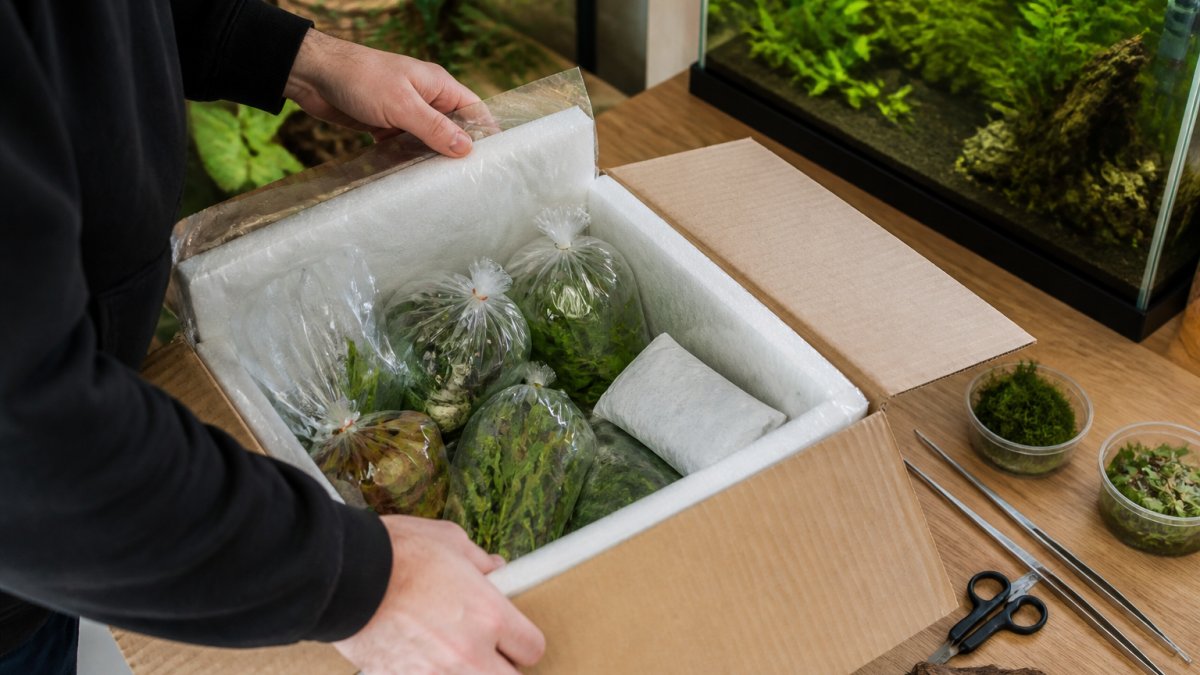
What a well-packed order looks like
A well-packed order arrives in an insulated box with plants bagged or wrapped, moisture retained, and a heat or cold pack when temperatures demand it. Plants should be labeled by species, because unlabeled stems are a guessing game over the tank. We ship same-day for overnight orders and include insulated boxes with heat or cold packs at no extra cost in extreme weather.
Seasonal risk and temperature holds
Shipping risk is not constant across the year. The two danger zones are summer heat and winter cold.
- Summer. A box left on a porch or in a mailbox can cook a plant in under an hour. Heat packs are not used in summer; the goal is insulation, shade, and a delivery window you can meet.
- Winter. Heat packs are used in winter, not cold packs. A plant that freezes in transit arrives limp and translucent and will not recover. Retailers that ship year-round either add heat packs automatically below a temperature threshold or hold shipments until the forecast improves.
- Shoulder seasons. Spring and fall are safest, but a late cold snap or early heat wave can still catch a shipment. The retailer should watch the forecast along your route, not just at the warehouse.
Experienced buyers request a hold when the forecast at either end of the route is extreme, then ship on the next safe day. That beats a replacement claim.
What to do when plants arrive damaged
Open the box the day it arrives, not the next morning. Inspect each plant for damage, pests, or rotting stems, and photograph anything wrong before you trim or plant it.
If a plant is dead on arrival, contact the retailer through the channel they specify with the order number and photo. If it is alive but melting, that is usually a thrive-policy claim with a longer window.
Stock, substitutions, and backorders
Stock reliability is the quiet variable in online plant shopping. Popular species sell out, and a retailer that does not say what happens next will surprise you.
- Substitution without notice. You ordered a specific Cryptocoryne and received a similar one. Ask before you order.
- Partial shipment. The retailer ships what is in stock and refunds the rest. Common and usually fair, but your aquascape plan may need a second order.
- Backorder hold. The retailer waits until everything is in stock, adding a week or more to transit risk. In shoulder season, that delay matters.
Preparing before the box lands
Prepare before the box lands. Have your tank running and at temperature, keep a bucket of dechlorinated water ready, and open the package the day it arrives. Do not leave plants in a mailbox in July, and in cold months bring the box inside immediately. Orders over $125 ship free overnight, which shortens the risk window.
How to Acclimate Aquarium Plants for Long-Term Success
Knowing how to acclimate aquarium plants separates a planting that takes hold from one that melts in two weeks. Acclimation is a short, deliberate process, not a long soak.
- Open the package immediately and inspect each plant for damage, pests, or rotting stems.
- Rinse the plants in dechlorinated water to remove shipping debris and any hitchhikers.
- Trim any brown, mushy roots or leaves with clean scissors.
- Place the plants in a bucket of tank-temperature dechlorinated water for 10-15 minutes.
- Plant or attach each species correctly: bury root feeders, tie epiphytes to hardscape with the rhizome exposed.
- Leave the lights on a normal schedule and skip fertilizer for the first few days.
A common mistake is burying an epiphyte's rhizome. Root feeders like Amazon Sword and Cryptocoryne Parva go into the substrate, with the sword needing at least two inches of depth. For background on plant nutrition and water chemistry, the U.S. Geological Survey's water science resources is a useful reference.
Pricing and Value: Which Aquatic Plant Store Fits Your Budget?
Total cost, not sticker price, is the number that matters. A $3.00 plant that melts twice costs more than a $5.50 plant that grows.
Our pricing runs from $3.00 for Cryptocoryne Parva to $18.75 for the Large Assorted Anubias on Driftwood, with most species between $4.00 and $5.50. Bundles change the math: the 8 Plant Variety Pack ($45.00) includes three stem plant bunches, a sword, a grass-like plant, a Cryptocoryne, an epiphyte, a fern, and free floaters.

Shipping tips the total further. Free overnight shipping on orders over $125 means a bundle plus a few extras often crosses the threshold, and overnight transit reduces loss claims.
| Product | Price | Best For |
|---|---|---|
| Cryptocoryne Parva | $3.00 | Cheapest carpeting foreground plant |
| Anacharis Najas | $4.00 | Fast-growing background or floating stem |
| Anubias Barteri var. "Nana" | $4.50 | Beginner foreground epiphyte |
| Amazon Sword | $5.00 | Large centerpiece for big tanks |
| Java Fern | $5.50 | Low-light epiphyte for hardscape |
| Vallisneria Americana "Corkscrew" | $5.50 | Tall background with runners |
| Red Root Floaters | $5.50 | Surface coverage and nutrient control |
| Large Assorted Anubias on Driftwood | $18.75 | Instant aquascape, no planting |
| 8 Plant Variety Pack | $45.00 | First planted tank, mixed species |
| 12 Plant Variety Pack | $60.00 | Larger setup or multiple tanks |
Conclusion
The hard part of buying plants online is not finding a store, it is finding one whose plants survive the trip and the first month in your tank.
Start with the 8 Plant Variety Pack ($45.00) if this is your first planted tank, or browse the full collection and let us match plants to your setup. Shop All Plants and get greenery that arrives ready to grow.
Frequently Asked Questions
What should I look for when buying aquarium plants online?
Check the retailer's plant sourcing and transition process, shipping guarantees, and customer support. Look for a live arrival guarantee and a policy covering plants that fail to thrive after planting. Confirm whether plants are grown submerged or emersed, since emersed-grown plants often melt when added to a tank. Also review shipping methods for extreme weather and whether the store offers real human support if something goes wrong.
How are live aquarium plants shipped?
Most retailers ship aquatic plants in insulated boxes with moisture-retaining material. During hot or cold weather, heat or cold packs are added to protect plants in transit. Some stores offer same-day shipping for overnight orders to reduce time in transit. Ask whether the retailer includes climate-controlled packaging at no extra cost, and confirm the carrier and expected delivery window before ordering.
How do I acclimate aquarium plants to my tank?
Open the bag and remove the plants. Inspect roots and leaves for pests, algae, or damaged tissue. Trim any dead roots or leaves with clean scissors. Place the plants in a bucket of tank-temperature dechlorinated water for 10-15 minutes. Plant or attach epiphytes to hardscape according to their needs, keeping rhizomes above the substrate. Monitor for melting over the first two weeks and remove decaying matter promptly.
What are the best low-tech aquarium plants for beginners?
Anubias Nana, Java Fern, Cryptocoryne Parva, and Amazon Sword are reliable low-tech choices. Anubias and Java Fern attach to driftwood or stone and need low to medium light. Crypt Parva works as a foreground carpet in any lighting. Amazon Sword grows large and works as a centerpiece in medium to high light. All of these tolerate a range of water parameters and do not require CO2 injection.
How much does it cost to buy aquatic plants online?
Prices vary by plant type and size. At Ohenrystanksalot, individual plants range from $3.00 for Cryptocoryne Parva to $5.50 for Java Fern, Vallisneria, or Red Root Floaters. Bundles offer better value: the 8 Plant Variety Pack is $45.00 and the 12 Plant Variety Pack is $60.00. Free overnight shipping applies on orders over $125. Compare total cost including shipping when evaluating retailers.