

7 Signs Your Hardy Aquatic Plants Need Fertilizer
Quick Summary
Hardy aquatic plants often grow well without added fertilizer, since fish waste and regular water changes supply many nutrients. Fertilizer becomes useful when plants show clear signs of deficiency, such as stalled growth or changing leaf color, and after light, carbon, and flow are ruled out.
- Hardy plants like Java fern and Anubias have low nutrient demands
- Check light, carbon, and flow before blaming a nutrient shortage
- Pale new leaves often point to low iron; yellow old leaves often point to low nitrogen
- Start liquid fertilizer at half the label dose and watch for two weeks
- Test nitrate first: readings of 20 ppm or higher mean more nitrogen will not help
Table of Contents
- 7 Signs Your Hardy Aquatic Plants Need Fertilizer
- Do Hardy Aquatic Plants Need Fertilizer at All?
- Where Aquarium Plants Get Their Nutrients Without Added Fertilizer
- Aquarium Plant Nutrient Deficiency Signs to Watch For
- Liquid Fertilizer vs Root Tabs for Aquarium Plants
- How Often to Fertilize Aquarium Plants and How to Dose Safely
- Is Aquarium Fertilizer Safe for Fish and Shrimp?
- Choosing Your Plants and Next Steps for Your Tank
- Frequently Asked Questions
7 Signs Your Hardy Aquatic Plants Need Fertilizer
Last Updated: October 29, 2026
Do Hardy Aquatic Plants Need Fertilizer at All?
Hardy aquatic plants often survive without added fertilizer, but not always. Ohenrystanksalot offers hardy plants that are grown without CO2 and fully transitioned for home tanks.
Whether your plants need fertilizer depends on three things: the plant species, what your tank already supplies, and what the plants look like. Hardy plants like Java fern and Anubias have low nutrient demands, while fast-growing stem plants and root feeders usually need more.
Here is the practical rule. If your plants grow steadily and look green, you probably do not need fertilizer. If growth stalls or leaves change color, something is missing. Check the plants before adding anything.
- Hardy plants often need little or no added fertilizer
- Demanding plants and fast growers usually need more
- Visible plant health is the best guide
Where Aquarium Plants Get Their Nutrients Without Added Fertilizer
Aquarium plants pull nutrients from water and, for some species, from the substrate. A healthy tank with fish and regular water changes supplies more food than most beginners expect.
How fish waste and water changes supply nutrients
Fish produce waste that breaks down into ammonia, then nitrate. Plants use nitrogen, so this cycle feeds them. Regular water changes add trace minerals from tap water and replace used nutrients. Together they keep many tanks in balance.
Watch out: A heavily stocked tank with few plants can build up excess nutrients and fuel algae. More fertilizer is not the fix in that case.
Root feeders versus water-column feeders
Root feeders draw most of their nutrients through their roots from the substrate. Swords and many crypts fall in this group, and they often need root tabs. Water-column feeders absorb nutrients directly from the water. Java fern, Anubias, and hornwort are examples. Those plants usually do well with liquid fertilizer or no fertilizer at all.
Aquarium Plant Nutrient Deficiency Signs to Watch For
Nutrient problems usually show up in the leaves first, but the same leaf symptoms can come from low light, poor carbon availability, or bad water flow. The trick is to rule out the non-nutrient causes before you dose anything.
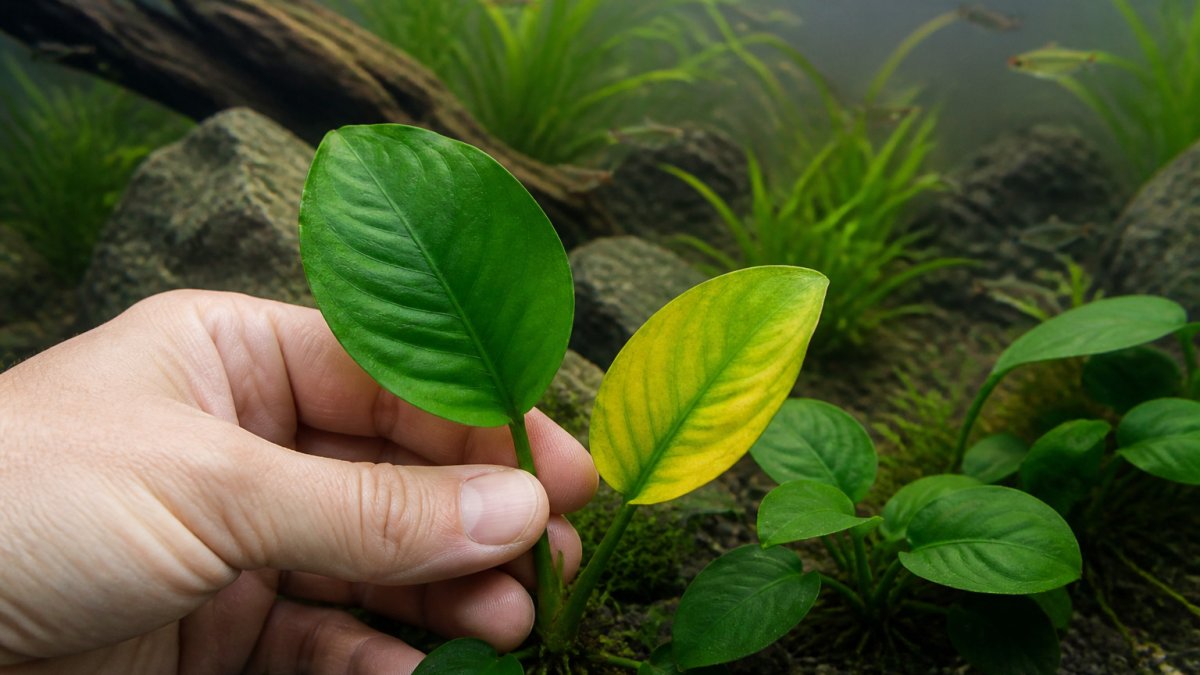
Step 1: Rule out light, carbon, and flow
Before you blame fertilizer, check these three things, because each one mimics a nutrient shortage:
- Light: If new leaves are small, pale, and spaced far apart on the stem (stretched internodes), the plant is reaching for light. More fertilizer will not fix that.
- Carbon: In a tank with no CO2 injection, growth slows and older leaves may yellow even when nutrients are present. That is a carbon limit, not a fertilizer limit.
- Flow: Dead spots let waste collect and starve leaves of dissolved nutrients. If one side of the tank looks worse, reposition the filter outlet before you buy fertilizer.
If light, carbon, and flow are reasonable and the plants still look off, move to Step 2.
Step 2: Read the symptom pattern
Nutrient deficiencies follow patterns. Match the pattern, not a single leaf:
- Pale or yellow new leaves while older leaves stay green: often low iron or another immobile nutrient. Common in tanks with soft water and no trace-element dosing.
- Yellow older leaves while new growth stays green: often low nitrogen. More likely in a lightly stocked tank with heavy plant mass and frequent large water changes.
- Small holes or pinholes in older leaves: often low potassium. A common pattern in tanks that dose only nitrogen and phosphorus.
Step 3: Confirm with a quick test
Test nitrate and phosphate before you dose. If nitrate reads near zero and your plants are yellowing from the bottom up, a nitrogen shortage is plausible. If nitrate is already 20 ppm or higher, adding more nitrogen will not help and may feed algae.
Step 4: Group your plants by need
Not every plant in the tank has the same appetite. Use this quick grouping to decide where to focus:
- Low need (usually fine without added fertilizer): Java fern, Anubias, Java moss, most mosses, and slow-growing crypts in a stocked tank.
- Moderate need (benefit from occasional liquid dosing): Amazon sword, most cryptocoryne species, and hornwort in a tank with moderate fish load.
- Higher need (usually need regular dosing): fast stem plants such as rotala, ludwigia, and hygrophila, plus carpeting plants in high light.
If your tank is mostly in the low-need group and the plants look healthy, you can skip fertilizer entirely. If you keep a mix, dose for the higher-need plants and watch the low-need ones for algae.
What deficiency is not
Some leaf damage is not a nutrient problem at all. Bites and ragged edges point to pests or fish. Melting stems right after planting usually mean the plant was grown emersed and is transitioning, not starving. Brown diatom film on leaves is common in newer tanks and clears up on its own. Rule these out before you reach for a bottle.
Anubias Barteri var. "Minima" →
Liquid Fertilizer vs Root Tabs for Aquarium Plants
Liquid fertilizer and root tabs are not competing products; they deliver nutrients to different parts of the plant. The right choice depends on how your plants feed and how your tank is set up. Here is a decision process you can run in a few minutes.
How each product actually works
- Liquid fertilizer dissolves in the water column. Water-column feeders absorb it through leaves and stems, and fast-growing stem plants take it up quickly. You can shop aquarium products to compare liquid options. It is easy to dose and easy to stop if algae appears.
- Root tabs are pressed into the substrate and release nutrients slowly at the root zone. Root feeders such as Amazon swords and most cryptocorynes draw most of their nutrition this way. Root tabs last longer between doses but are harder to remove once buried.
A quick decision framework
Answer these four questions in order:
- Where do most of your plants feed? If the tank is mostly Java fern, Anubias, moss, and floating plants, liquid fertilizer is the better fit. If it is mostly swords and crypts in gravel or sand, root tabs do more for you.
- How fast do your plants grow? Fast stem plants in moderate to high light usually need regular liquid dosing. Slow growers in low light often need nothing.
- What does your substrate hold? Inert gravel and sand hold almost no nutrients, so root feeders in those substrates benefit from root tabs. Nutrient-rich aquasoils already supply root-zone nutrition for months and may not need tabs at first.
- How heavily stocked is the tank? Fish waste supplies nitrogen and phosphorus. A heavily stocked tank with light plant mass may need no fertilizer at all; a lightly stocked tank with heavy plant mass usually needs more.
Plant-by-plant starting point
Use this grouping to decide what to buy first:
- Water-column feeders (liquid fertilizer): Java fern, Anubias, hornwort, floating plants, and most stem plants.
- Root feeders (root tabs): Amazon sword, cryptocoryne species, and other rosette plants rooted in gravel or sand.
- Mixed tanks: Many setups benefit from both, but start with the group that makes up most of your plant mass. Adding both at once makes it hard to tell what worked.
What to look for on the label
Not every fertilizer contains the same nutrients, so read the ingredient list before you buy:
- Macronutrients: nitrogen, phosphorus, and potassium (often listed as N-P-K).
- Micronutrients: iron, manganese, boron, zinc, and others. Iron is the one most often missing in soft water.
- Form: some liquids are all-in-one; others are split into macro and micro bottles that you dose separately.
Cost and dosing trade-offs
Match the purchase to your plant mix rather than buying both by default.
The two products feed different parts of the plant, so the right choice depends on how your plants take in nutrients.
| Product | Best for | Key difference |
|---|---|---|
| Liquid fertilizer | Java fern, Anubias, hornwort, floating plants, most stem plants | Dissolves in the water column; easy to stop if algae appears |
| Root tabs | Amazon sword, cryptocoryne species, other rosette plants | Pressed into substrate; releases slowly at the root zone |
How Often to Fertilize Aquarium Plants and How to Dose Safely
Start small. Begin with half the dose on the label and watch the plants for two weeks.
Follow these steps:
- Test your water for nitrates and phosphates
- Pick a product that matches your plant type
- Dose at half strength for the first month
- Watch new growth for signs of improvement or excess
- Cut back if algae appears
Watch out: Overdosing fuels algae and can harm fish. If algae shows up, reduce the dose or skip a week.
Is Aquarium Fertilizer Safe for Fish and Shrimp?
Most aquarium fertilizers are safe for fish and shrimp when used as directed. Problems usually come from overdosing, not normal use. Keep the dose low, watch your livestock, and perform regular water changes.
Shrimp are more sensitive to changes in water chemistry than many fish. Dose gradually and avoid adding large amounts at once. If you see stress or unusual behavior, do a partial water change and review your dosing.
Choosing Your Plants and Next Steps for Your Tank
If your plants need help, you have options. For a low-maintenance tank, choose hardy plants and add fertilizer only when the signs appear. Ohenrystanksalot sells Anubias Barteri var. "Minima", Anubias Barteri var. "Nana", and Ceratophyllum Demersum, "Hornwort", which are low-maintenance options for hardy tanks.


Before you buy any fertilizer, look over the plants you already have.
Frequently Asked Questions
How often do aquarium plants need fertilizer?
Hardy plant needs vary, and many tanks with fish stocking and regular water changes need little or no added fertilizer. Dose according to the product label, starting at half strength, and adjust based on how the plants look over several weeks. If new growth is pale or older leaves yellow, increase frequency slightly. If algae appears, cut back. Testing water for nitrate and phosphate helps you decide before you add anything.
Can fish waste provide enough nutrients for aquarium plants?
Fish waste breaks down into ammonia, then nitrate, which plants can absorb. In a lightly planted tank with a moderate fish load, this can supply enough nitrogen for hardy species such as Anubias, Java fern, and Hornwort. However, fish waste rarely supplies enough phosphorus, potassium, or iron, so plants may still show deficiencies over time. Regular water changes also remove some of these nutrients, which is why many hobbyists add a small amount of fertilizer to support growth.
Should I use root tabs or liquid fertilizer for aquarium plants?
Root feeders such as Vallisneria and Amazon swords draw nutrients from the substrate, while water-column feeders such as Hornwort and many stem plants absorb nutrients through their leaves. Many hobbyists use both: root tabs for rooted plants and a light liquid dose for the whole tank. Choose based on your plant mix rather than a single product.
Can too much aquarium fertilizer harm fish or shrimp?
Yes, overdosing can harm fish and shrimp, particularly when excess nutrients fuel algae blooms that reduce oxygen and water quality. Shrimp are more sensitive to copper-based additives, so check labels carefully and avoid copper-containing products in shrimp tanks. Dose conservatively, test your water weekly, and perform partial water changes if levels climb. Stop dosing and do a water change if fish appear stressed or algae spreads quickly.
